Saturday, January 25, 2014

The Myth of Maximizing Shareholder Value

Jamie Dimon (courtesy of Steve Jurvetson/Wikimedia Commons)
Profit maximization is often taught to law and business students as a primary driver for corporate leaders in the United States.  Put another way, students learn that corporate executives are bound to consider shareholder enrichment as a primary motivator in their leadership of U.S. corporations.  While critics like Lynn Stout and Yves Smith decry this notion as false, the duty of "profit maximization," the principle persists, as if members of corporate boards and company executives spend much of their time planning how to increase profits for the shareholders that ostensibly hire them.  In my own writing and thinking, I am convinced that profit maximization is no myth but just misconstrued; profit maximization does exist for corporate leaders, but not for increasing shareholder profit, but for increasing their OWN profit.  Stated differently, if profits increase for a corporation, that often means that executive compensation will increase remarkably if corporations show a successful bottom line.  So evidence suggests that corporate leaders make decisions that will increase their own bottom line, rather than that of the company's owners, the shareholders.

At Naked Capitalism, Yves Smith writes that the notion of shareholder profit maximization is bunk.  He writes:  "So many of the assertions made about 'maximizing shareholder value' are false that they should be assumed to be a lie until proven otherwise. The first is that board and managements are somehow obligated to 'maximize shareholder value' is patently false. Legally, shareholders’ equity is a residual claim, inferior to all other obligations. Boards and management are required to satisfy all of the company’s commitments, which include payments to vendors (including employees), satisfying product warranties, paying various creditors, paying taxes, and meeting various regulatory requirements (including workplace and product safety rules and environmental regulations)."

Rather, Smith continues "For the past three decades, top executives have been rewarding themselves with mega-million dollar compensation packages while American workers have suffered an unrelenting disappearance of middle-class jobs. Since the 1990s, this hollowing out of the middle-class has even affected people with lots of education and work experience.  As the Occupy Wall Street movement correctly recognized, the concentration of income and wealth of the economic top 'one percent' of society has left the rest of us largely high and dry. Corporate profits are increasingly going to share buybacks or dividend distribution, but very little is going back into research and development efforts, capital reinvestment, and employment. Corporations, in other words, are devoting increasing amounts of their considerable and growing financial resources to redistribution rather than innovation. And they are doing so based on the justification of 
'increasing shareholder value.'"

This redistribution of wealth is from corporate coffers into corporate executives pockets, NOT to shareholders or charitable organizations.  Evidence of this comes this week with reports that Jamie Dimon, CEO of JP Morgan Chase (pictured above), has been rewarded a 74% pay hike (18.5 million dollar bonus), despite a very rocky past two years of leadership where JP Morgan has paid billions of dollars in fines for regulatory failures.

Redistribution of wealth occurs in the United States, just not in the way folks are often led to believe.  Corporate profits are increasingly landing in the pockets of the 1%, not in the pockets of the shareholders.

Wednesday, January 22, 2014

Mid-Atlantic People of Color Legal Scholarship Conference 2014

University of Baltimore School of Law
The Mid-Atlantic People of Color Legal Scholarship Conference will hold its annual meeting on January 23-25, 2014, at the University of Baltimore School of Law.  The Conference theme is "President Lyndon B. Johnson's Great Society and Beyond: The Historical and Contemporary Implications of Progressive Action and Human Fulfillment - Honoring and Critiquing the 50th Anniversary of Johnson's Vision."  In considering Johnson's "Great Society" in 2014, one must evaluate whether the problems of poverty, education, civil rights and equality, and crime have been effectively handled over the past 50 years.

From the conference website:  "In May 1964, President Lyndon Baines Johnson unveiled his revolutionary plan for a “Great Society.” As he explained it, Americans had 'the opportunity to move not only toward the rich society and the powerful society, but upward to the Great Society. … The Great Society rests on abundance and liberty for all. It demands an end to poverty and racial injustice.'

According to Doris Kearns Goodwin, author of Lyndon Johnson and the American Dream, Johnson’s Great Society would be based on “progressive action” and the “possibilities for human fulfillment.” These ideas meant Americans needed to regain control over their society and end policies that threatened and degraded humanity.

With the passage of Johnson’s Great Society reforms—including the Voting Rights Act of 1965, Medicare, Medicaid, the Equal Opportunity Act, the Elementary and Secondary Education Act, Social Security, the Earned Income Tax Credit, the Higher Education Act, Head Start, the Civil Rights Acts of 1964 and the Housing and Urban Development Act of 1965—America’s official poverty rate declined throughout the 1960s and early 1970s, reaching a low of 11.2 percent in 1974, down from 19 percent in 1964. (The rate was 15.1 percent in 2010.)

According to Washington Post reporter Dylan Matthews, who in 2011 wrote 'Poverty in the 50 years since ‘The Other America,’ in five charts,' Johnson’s Great Society programs—which included the War on Poverty—made a 'real and lasting difference.'

But some of Johnson’s less fortunate legacies are still with us: the effects of the Vietnam War, which Johnson escalated, as well as racially concentrated poverty. In the decades since his presidency, America has weathered several recessions, the 1990s boom years, the 2008 financial collapse and the continuing slump brought on by banking policies and Wall Street’s disastrous gambit of issuing mortgage-backed securities, as well as the national security apparatus’ encroachment on civil liberties, the rise and fall of the Occupy Movement and the Arab Spring, and the wars since 9/11.

It is clear that Johnson’s Great Society programs saved millions of Americans from the depth of official poverty. It is also true that Johnson’s great plan failed as his presidency was rocked by opposition to the Vietnam War and urban unrest across the country, notably by the 1965 Watts riots. Johnson never did redress poverty in America."

Scholars of color will examine and address the promise of Johnson's grand proposals and examine where we stand today and what challenges remain.

Monday, January 20, 2014

MLK Day and Citizen's United

courtesy of Marion S. Trikosko/Library of Congress
In an AlterNet article appearing today, the day we celebrate the legacy of Dr. Martin Luther King, Jr., entitled "As We Celebrate MLK Day . . . Tomorrow's Anniversary of Citzen's United Reminds Us of Increasing Injustice," Professor Ian Haney Lopez discusses the connection between Dr. King's economic equality message which dominated the final years of his life, and increasing wealth inequality in America, represented strongly by the Supreme Court's Citizen's United opinion.

Per AlterNet:  "Monday is the national holiday honoring Martin Luther King Jr., and  Tuesday marks the fourth anniversary of Citizens United, the case that dramatically widened the flood of big money in elections. Their confluence is opportune, for while each seems to invite reflection on a different core social problem—respectively racial inequality and the power of concentrated wealth—each teaches lessons relevant to the other.

King clearly saw how racial and economic justice formed mutual requirements. The strike by African American sanitation workers in Memphis, where King was assassinated, reflected the truth that racial justice for minorities would depend on economic opportunities. In the other direction, the Poor Peoples’ March on Washington that King labored for in the months before his death arose out of the conviction that economic security for persons of every race depended on transcending racial divisions."

Thursday, January 16, 2014

Derivatives and Deregulation

Russel Funk and Daniel Hirschman, both PhD candidates at the University of Michigan, have just released an interesting paper entitled "Derivatives and Deregulation: Financial Innovation and the Demise of Glass-Steagall."  In the paper, they look closely at the first major currency swap in history, a 1981 exchange between IBM and the World Bank, and trace how this financial innovation (swaps primarily) literally drove the demise of the firewall between commercial and investment banks established in the 1933 Glass-Steagall Act. 

Here is the abstract:

"Just as regulation may inhibit innovation, innovation may undermine regulation. Regulators, much like market actors, rely on categorical distinctions to understand and act on the market. Innovations that are ambiguous to regulatory categories but not to market actors present a problem for regulators and an opportunity for innovative firms to evade or upend the existing order. We trace the history of one class of innovative financial derivatives — interest rate and foreign exchange swaps — to show how these instruments undermined the separation of commercial and investment banking established by the Glass-Steagall Act of 1933. Swaps did not fit neatly into existing product categories — futures, securities, loans — and thus evaded regulatory scrutiny for decades. The market success of swaps put commercial and investment banks into direct competition, and in so doing undermined Glass-Steagall. Drawing on this case, we theorize some of the political and market conditions under which regulations may be especially vulnerable to disruption by ambiguous innovations."

The paper can be downloaded here.

Sunday, January 5, 2014

Dog Whistle Politics

Professor Ian Haney López has just released his latest important book Dog Whistle Politics:  How Coded Racial Appeals Have Reinvented Racism and Wrecked the Middle Class.

Description:  "Campaigning for president in 1980, Ronald Reagan told stories of Cadillac-driving 'welfare queens' and 'strapping young bucks' buying T-bone steaks with food stamps. In trumpeting these tales of welfare run amok, Reagan never needed to mention race, because he was blowing a dog whistle: sending a message about racial minorities inaudible on one level, but clearly heard on another. In doing so, he tapped into a long political tradition that started with George Wallace and Richard Nixon, and is more relevant than ever in the age of the Tea Party and the first black president.

In Dog Whistle Politics, Ian Haney López offers a sweeping account of how politicians and plutocrats deploy veiled racial appeals to persuade white voters to support policies that favor the extremely rich yet threaten their own interests. Dog whistle appeals generate middle-class enthusiasm for political candidates who promise to crack down on crime, curb undocumented immigration, and protect the heartland against Islamic infiltration, but ultimately vote to slash taxes for the rich, give corporations regulatory control over industry and financial markets, and aggressively curtail social services. White voters, convinced by powerful interests that minorities are their true enemies, fail to see the connection between the political agendas they support and the surging wealth inequality that takes an increasing toll on their lives. The tactic continues at full force, with the Republican Party using racial provocations to drum up enthusiasm for weakening unions and public pensions, defunding public schools, and opposing health care reform.

Rejecting any simple story of malevolent and obvious racism, Haney López links as never before the two central themes that dominate American politics today: the decline of the middle class and the Republican Party's increasing reliance on white voters. Dog Whistle Politics will generate a lively and much-needed debate about how racial politics has destabilized the American middle class -- white and nonwhite members alike."

Wednesday, January 1, 2014

Happy New Year

courtesy of Alex Simms/Wikimedia Commons


We at the Corporate Justice Blog are grateful to our readers, commentators, and contributors.  Thanks to all of you that support our work, challenge our insights, and work with us toward social and economic justice.  Happy New Year to all of our readers and supporters.  We wish everyone a safe and prosperous 2014.

Let us hope and work together for fairness and economic equality.

Monday, December 30, 2013

Important Stories to Close Out the Year

As 2013 draws to a close, two important events have occurred in December that bear mentioning as the world prepares to usher in 2014.  In connection with America's epic failure, the War on Drugs:

First, A Divided Federal Court Rules Crack Cocaine Sentencing Reforms Do No Apply to Those Already in Prison:
In a blow to those sentenced under grossly unfair crack cocaine versus powder cocaine sentencing requirements, the Sixth Circuit Court of Appeals ruled in early December that the new sentencing regime ushered in under the 2010 Fair Sentencing Act does not apply retroactively to those currently sitting in prison.  From the NAACP release: "[A] sharply divided Sixth Circuit Court of Appeals ruled that the Fair Sentencing Act (FSA), which reduced the unfair, unjustified, and racially discriminatory crack cocaine/powder cocaine sentencing ratio from 100-to-1 to 18-to-1, does not apply to thousands of individuals who are currently incarcerated pursuant to sentences imposed under the discredited 100-to-1 regime.  Seven judges concluded that the FSA should apply to those serving sentences under the 100-to-1 federal sentencing structure, and ten judges declared that it should not."

"'We are deeply disappointed in the outcome of this case. Thousands of people, the majority of whom are African-American, are still serving time under an unfair drug sentencing regime that has destroyed individuals, families and communities. Today’s decision demonstrates that those who are working to eliminate the impermissible role of race in criminal prosecutions and sentences still have much more work to do. We will continue to press this issue in the court,' said Sherrilyn A. Ifill, President and Director-Counsel of the NAACP Legal Defense and Educational Fund, Inc., a leading civil rights law firm and a separate entity from the NAACP."

President Obama, Congress, Federal Courts, and the United States Supreme Court must act immediately to  begin commuting the sentences of those individuals imprisoned under the grossly unfair 100:1 sentencing disparity between crack and powder cocaine.

Second, President Obama Commutes the Sentences of Eight Crack Cocaine Offenders:
President Obama, recognizing that thousands of inmates are jailed under patently unfair sentencing policies in connection with crack cocaine and powder cocaine sentences, began what can fairly be hoped for as the beginning of righting past wrongs, commuted the sentences of eight crack cocaine offenders who have served prison time for more than 15 years, and would be out of prison, had they been sentenced under powder cocaine guidelines.

Congress passed the Fair Sentencing Act in 2010 which, according to The Root, "reduced the disparity in sentencing between offenses for crack and powder cocaine from 100:1 to 18:1. The 100:1 ratio meant that people involved in offenses for crack cocaine faced longer sentences that those involving the same amount of powder cocaine."  The New York Times reports that President Obama released the following statement: 

"'This law began to right a decades-old injustice, but for thousands of inmates, it came too late,' the president said in a release given to the media. 'If they had been sentenced under the current law, many of them would have already served their time and paid their debt to society.  Instead, because of a disparity in the law that is now recognized as unjust, they remain in prison, separated from their families and their communities, at a cost of millions of taxpayer dollars each year.'"

Let's hope for much more of the same in 2014.

Sunday, December 29, 2013

Volcker Rule Melting Fast

The almost toothless Volcker Rule imposed earlier this month seems poised to be further defanged. Apparently some banks hold a certain type of CDO that is not permitted under the new rule. They do not have to dispose of it anytime soon, mind you, but they can no longer pretend that they intend to hold it to maturity. That means it must be marked to market. Banks therefore must recognize losses and take hits to capital. Thus, Zions Bank recognized a $387 million loss on CDOs it previously marked at cost but now must be marked to market due to the fact that sooner or later (especially later) they may not be able to continue holding such securities in the future. Apparently many banks are in the same position as Zions and they too would rather not acknowledge their market losses.

I would argue the rule is actually beneficial here. Accounting rules should reflect reality not fantasy. The market losses are real and these securities would not be valued so low if they were safe and would pay-off in due cross. Losses also signal to banks that they cannot escape accountability for poor investment decisions by pretending the losses do not exist.

But, the American Bankers Association would have none of it and sued to challenge the rule. Given the natural proclivities of the judicial system in favor of the most wealthy and powerful (who can afford to hire hoards of lawyers) a judicial challenge to the Volcker Rule in not likely to result in an economically sound ruling.

Worse, however, it appears the regulators simply intend to fold. They recently announced that they intend to  review the rule in light of the ABA's complaint.

Wednesday, December 11, 2013

Volcker Rule: Still Much Ado About Nothing

So a few days after Dodd-Frank became law I posited that the so-called Volcker Rule would do little to solve excessive speculation by banks subsidized by the federal government through deposit insurance, or otherwise. Here is what I said then.

Yesterday, the Fed released its final rules on the Volcker Rule. Compare their release with my summary from 2010, here.

The bottom line is that megabanks may still engage in all kinds of speculative activities. Here is the money quote from the Fed:  "Like the Dodd-Frank Act, the final rules provide exemptions for certain activities, including market making, underwriting, hedging, trading in government obligations, insurance company activities, and organizing and offering hedge funds or private equity funds. The final rules also clarify that certain activities are not prohibited, including acting as agent, broker, or custodian." In other words the megabanks can be investment banks with government backing.

The rules take effect July 21, 2015. This can be extended by the Fed.

Frankly, I cannot see how these rules change anything. More to come. . .

Saturday, November 30, 2013

The Leading Subprime Lenders Most Responsible for the Mortgage Meltdown

As promised, below is the 2009 list of the top 25 subprime lenders that crushed the U.S. housing market in 2007-08.  As discussed earlier this week, nearly every executive at the below banks have more than landed on their feet and are now reengaged in the business of writing loans . . .

Courtesy of The Center for Public Integrity:

"These top 25 lenders were responsible for nearly $1 trillion of subprime loans, according to a Center for Public Integrity analysis of 7.2 million “high interest” loans made from 2005 through 2007. Together, the companies account for about 72 percent of high-priced loans reported to the government at the peak of the subprime market. Securities created from subprime loans have been blamed for the economic collapse from which the world’s economies have yet to recover.
  1. Countrywide Financial Corp.
    Amount of Subprime Loans: At least $97.2 billion
  2. Ameriquest Mortgage Co./ACC Capital Holdings Corp.
    Amount of Subprime Loans: At least $80.6 billion
  3. New Century Financial Corp.
    Amount of Subprime Loans: At least $75.9 billion
  4. First Franklin Corp./National City Corp./Merrill Lynch & Co.
    Amount of Subprime Loans: At least $68 billion
  5. Long Beach Mortgage Co./Washington Mutual
    Amount of Subprime Loans: At least $65.2 billion
  6. Option One Mortgage Corp./H&R Block Inc.
    Amount of Subprime Loans: At least $64.7 billion
  7. Fremont Investment & Loan/Fremont General Corp.
    Amount of Subprime Loans: At least $61.7 billion
  8. Wells Fargo Financial/Wells Fargo & Co.
    Amount of Subprime Loans: At least $51.8 billion
  9. HSBC Finance Corp./HSBC Holdings plc
    Amount of Subprime Loans: At least $50.3 billion ***
  10. WMC Mortgage Corp./General Electric Co.
    Amount of Subprime Loans: At least $49.6 billion
  11. BNC Mortgage Inc./Lehman Brothers
    Amount of Subprime Loans: At least $47.6 billion ***
  12. Chase Home Finance/JPMorgan Chase & Co.
    Amount of Subprime Loans: At least $30 billion
  13. Accredited Home Lenders Inc./Lone Star Funds V
    Amount of Subprime Loans: At least $29.0 billion
  14. IndyMac Bancorp, Inc.
    Amount of Subprime Loans: At least $26.4 billion
  15. CitiFinancial / Citigroup Inc.
    Amount of Subprime Loans: At least $26.3 billion
  16. EquiFirst Corp./Regions Financial Corp./Barclays Bank plc
    Amount of Subprime Loans: At least $24.4 billion
  17. Encore Credit Corp./ ECC Capital Corp./Bear Stearns Cos. Inc.
    Amount of Subprime Loans: At least $22.3 billion
  18. American General Finance Inc./American International Group Inc. (AIG)
    Amount of Subprime Loans: At least $21.8 billion ***
  19. Wachovia Corp.
    Amount of Subprime Loans: At least $17.6 billion.
  20. GMAC LLC/Cerberus Capital Management
    Amount of Subprime Loans: At least $17.2 billion ***
  21. NovaStar Financial Inc.
    Amount of Subprime Loans: At least $16 billion
  22. American Home Mortgage Investment Corp.
    Amount of Subprime Loans: At least $15.3 billion
  23. GreenPoint Mortgage Funding Inc./Capital One Financial Corp.
    Amount of Subprime Loans: At least $13.1 billion
  24. ResMAE Mortgage Corp./Citadel Investment Group
    Amount of Subprime Loans: At least $13 billion
  25. Aegis Mortgage Corp./Cerberus Capital Management
    Amount of Subprime Loans: At least $11.5 billion
***Total includes subsidiaries"

Tuesday, November 26, 2013

Checking Back In On the Mortgage Crisis Perpetrators

Five years after the collapse of Lehman Brothers which ushered in the crushing mortgage crisis of 2008, perpetuated primarily by subprime lenders, it appears that those most at fault for originating, selling and packaging predatory subprime loans are fully back in business.  Most now agree that lowered lending standards, predatory loans, and an insatiable Wall Street appetite for packaging loans into investment instruments, all at massive profit margins, led to the 2007-08 implosion of global markets.  Now, those individuals most responsible for creating the reckless loans that enabled the crisis have reentered the lending market after facing next to no genuine discipline for their recklessness.

According to The Center for Public Integrity's report Subprime Lending Execs Back in Business Five Years After Crash: "Five years after the financial crisis crested with the bankruptcy of Lehman Brothers Holdings Inc., top executives from the biggest subprime lenders are back in the game. Many are developing new loans that target borrowers with low credit scores and small down payments, pushing the limits of tighter lending standards that have prevailed since the crisis.  Some experts fear they won’t know where to stop.

The Center for Public Integrity in 2009 identified the top 25 lenders by subprime loan production from 2005 through 2007. Today, senior executives from all 25 of those companies or companies that they swallowed up before the crash are back in the mortgage business. Most of these newer “non-bank” lenders are making or collecting on loans that may be too risky to qualify for backing by the U.S. government. As the industry regains its footing, these specialty lenders represent a small but growing portion of the market."

As always seems to be the case when financial fraud and debauchery are involved, U.S. citizens continue to struggle economically, as foreclosures and joblessness continues, meanwhile, banking executives that engaged in the reckless lending that led to the market collapse are back at it with very little meaningful or realistic consequences. Later this week, I will post the list of the top 25 subprime lenders from 2005 to 2007, whose executives are now fully re-engaged in the loan business.

Wednesday, November 20, 2013

Occupy Wall Street-Where Did You Go?: The Widening American Wealth Gap

I just ran across a thought provoking article on CNN-Money entitled the "Split Economy."  The article reminds us that "[t]he divide between the 'haves and the 'have-nots' has never been greater."  "And every day brings a reminder of the rich making and spending huge sums of money  while the poor struggle to support their basic needs."  The article juxtaposes examples of wealth and conspicuous consumption against images of dire poverty in our country.  Here go examples:

  • Dow 16,000-Stock market hits all-time high - 46.5 million Americans still living in poverty;

  • Painting fetches record $142.4 million in auction - 47.5 million need food stamps to buy groceries;

  • Twitter IPO created 3 billionaires - On the same day, 5 Wal-Mart workers arrested while striking for higher pay;

  • NYC apartment listed for $125 million - A record 1.2 K-12 students are homeless;

  • Lamborghini Veneno goes on sale for $4.5 million - Public transportation fare hikes across the US. 
This just makes me ask-Occupy Wall Street-Where did you go?  At least the Occupy Wall Street Movement kept the woes of the 99% in the news for a while.  Today, it is easy to become complacent and detached and forget to look around and spot the issues that are plaguing our society.  This article was food for thought.  I hope you find it thought provoking as well.   

Thursday, November 7, 2013

Hedge Fund Giant SAC Capital Pleds Guilty to Criminal Insider Trading Charges

Hedge fund giant SAC Capital pled this week to criminal insider trading charges leveled by the Securities and Exchange Commission ("SEC").  As part of the plea deal, SAC Capital agreed to pay a record $1.8 billion fine for engaging in insider trading.  Additionally, prosecutors announced that SAC Capital will shatter it's investment advisory business--in essence ending the hedge funds ability to manage money for outside investors.  This does not mean that SAC Capital is dead.  The plea deal still allows SAC Capital's founder, billionaire Steve Cohen, to operate the firm as a "family office," to invest  Cohen's and other SAC Capital insider's own money. 

Cohen is one of the nation's most high flying hedge fund managers.  Cohen has an estimated net worth of $9.4 billion.  It remains an open question as to whether or not the SEC plans to bring criminal insider trading charges against Cohen.  Cohen is facing civil liability in connection with civil charges the SEC brought against him in July, for failing to supervise employees engaged in insider trading. 

Federal prosecutors alleged that SAC Capital engendered a institutional culture of blatant insider trading "that was substantial, pervasive, and on a scale without precedent."  A number of instant messages and emails among SAC Capital traders suggested and insinuated that these traders had obtained illicit inside information from corporate insiders.

SAC Capital's legal troubles have had an impact on investors.  as of January 1, 2013, SAC Capital managed $15 billion in assets, today the firm only manages approximately $9 billion in assets, mostly all of which belongs to Cohen and other employees.  SAC Capital's legal troubles are not new.  In March of 2013, SAC Capital agreed to pay $616 million to settle allegations of insider trading in a separate SEC initiated civil action.  Monday's plea deal will count this earlier amount paid in settlement of the civil charges-SAC Capital will have to come up with an additional $1.2 billion to settle the criminal charges.    

Wednesday, October 30, 2013

Tea Party Devastation to US Mounts


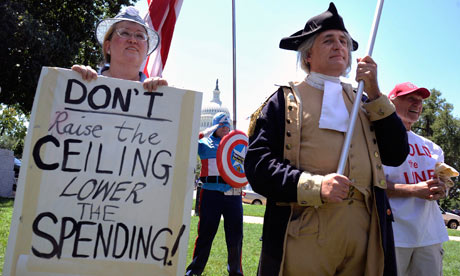
Tea Party debt protest The Tea Party's campaign to permanently disable the US government inflicted a massive toll on the US economy, according to a series of recent reports. Let's start with consumer confidence:


U.S. consumer confidence fell sharply in October as Americans reacted to the Congressional impasse over the debt ceiling and 16-day partial government shutdown earlier this month, according to a survey released Tuesday by The Conference Board. The independent research firm reported the index fell more than expected to 71.2 from 80.2 in September. Economists surveyed by Bloomberg expected an October figure of 75. Those expecting business conditions to improve over the next six months fell to 16 percent from 20.6 percent. The drop in confidence was the biggest decline since August 2011, when lawmakers were also battling to reach a budget deal and threatening a government shutdown.

Consumer confidence plays a key role in macroeconomic performance as a loss of confidence leads to less spending on everything from Halloween to tourism which in turn chills jobs growth and constricts employment opportunities.

The loss in jobs was manifest today in the latest payroll report, as reported by economist Mark Zandi:

The government shutdown and debt limit brinksmanship hurt the already softening job market in October. Average monthly growth has fallen below 150,000. Any further weakening would signal rising unemployment. The weaker job growth is evident across most industries and company sizes.

As recently as April, the economy was creating 224,000 jobs per month. Essentially, the Tea Party leadership is now tossing over 75,000 American families under the bus for no apparent reason. Job growth already suffered from the sequestration cuts demanded by the Tea Party in 2011--by as much as a million jobs per year.

The bottom line is that the Tea Party leadership inflicted massive economic damage on the US economy through its constant flirtation with default. According to a USA Today survey of 41 top economists the tab is likely to amount to $27 billion over the next six months--from the most recent budget battle alone.

I am slowly coming to the conclusion that many Tea Party leaders hate America through their actions regardless of their words. Mainstream GOP voices increasingly recognize the damage the Tea Party is inflicting. As longtime GOP supporter and Home Depot founder Ken Langone asked a GOP House member: "What the hell did you guys gain by shutting the government down other than to get a black eye for all of us?" The response from House Republican Policy Committee Chairman James Lankford of Oklahoma: "I would agree. We got a black eye on it. The problem that we have is we overreached."

Saturday, October 26, 2013

JP Morgan's Settlement of Duplicity Charges

Yesterday, JP Morgan Chase agreed to settle claims that it sold toxic mortgages to government-sponsored enterprises Fannie Mae and Freddie Mac by misrepresenting the quality of the mortgages that it sold to the GSE's during the run-up to the financial market crisis.  JP Morgan agreed to pay $5.1 billion dollars to Fannie Mae and Freddie Mac disclaiming wrongdoing but adding to a rough year of controversy for the Wall Street banking giant.

According to CNN/Money: "The claims relate to conduct at JPMorgan and at Bear Stearns and Washington Mutual, which JPMorgan purchased in 2008. At issue are allegations that the firms sold risky mortgages and mortgage securities while misrepresenting their quality. Among the purchasers were Fannie Mae and Freddie Mac, the government-backed housing finance giants that required a massive bailout in 2008 when their housing investments soured. The deal was announced by the Federal Housing Finance Agency, which has overseen Fannie and Freddie since their 2008 rescue. . . .

JPMorgan will pay $4 billion to resolve claims related to the alleged misrepresentation of mortgage-backed securities - investment products created by bundling payments from individual loans. It will also repurchase $1.1 billion worth of mortgages sold to Fannie and Freddie between 2000 and 2008 that the firms say do not meet their quality standards."

According to Bloomberg:  "The [Federal Housing Finance Authority] had accused JPMorgan and its affiliates of making false statements and omitting material facts in selling about $33 billion in mortgage bonds to the two companies [Fannie and Freddie] from Sept. 7, 2005, through Sept. 19, 2007.  Executives at JPMorgan, Washington Mutual and Bear Stearns Cos., which was also acquired by JPMorgan in 2008, knowingly misrepresented the quality of the loans underlying the bonds, the regulator wrote in the lawsuit in federal court in Manhattan."

Interestingly, in the early post-market crash days, when individuals were rushing to place blame, a clear vocal minority attempted to place full blame for the mortgage crisis on Fannie Mae and Freddie Mac basically arguing that the GSE's created an environment where mortgages of all sizes and shapes would be repurchased by the GSE's, sans standards.  Now, with JP Morgan agreeing to buy back over $1 billion in mortgages and mortgage-backed securities that it misrepresented to the GSE's in the first place, it appears clear that the quality of mortgages sold to the housing giants were fraudulently misrepresented, as historic standards existed for the GSE's in what types of mortgages it would actually purchase from private banks.  Fraud, essentially, was engaged in by Wall Street and commercial banks like Washington Mutual, Countrywide, JP Morgan, Bear Stearns, etc., leading in part to the mortgage crisis that continues to hinder economic growth today.

Despite engaging in alleged fraud, $5.1 billion represents just a fraction of JP Morgan's profits.  "JPMorgan is large enough to easily absorb the settlement costs. It's the biggest bank in the nation, with assets of $2.5 trillion and net income of $21.3 billion in 2012."  That said, "[t]he bank has been buffeted by legal problems in the past few months, however. It has paid over $1 billion in fines in connection with last year's 'London Whale' trading debacle, and $80 million more over its allegedly unfair credit card billing practices."