Tuesday, May 14, 2013

JP Morgan, Again?


Once again, JP Morgan Chase finds itself at the center of controversy.  Casual Wall Street observers must be asking themselves, "will these bankers never learn"?  This time government regulators are accusing the investment banking giant of illegally manipulating energy prices in order to drive up revenue for themselves and investors.  Regulators cite to a document indicating knowledge and approval of bank executives of schemes carried out by a group of energy traders in Houston. According to DealBook:

"Government investigators have found that JPMorgan Chase devised 'manipulative schemes' that transformed 'money-losing power plants into powerful profit centers,' and that one of its most senior executives gave 'false and misleading statements' under oath.

The findings appear in a confidential government document, reviewed by The New York Times, that was sent to the bank in March, warning of a potential crackdown by the regulator of the nation’s energy markets."

Thursday, May 9, 2013

"You Can Sell Your Shares"

Howard Schultz - CEO Starbucks Corporation
Starbucks CEO Howard Schultz was very pointed when challenged by a shareholder at the coffee giant's annual meeting for publicly supporting marriage equality in the state of Washington.  When asked whether he felt that supporting gay marriage drove customers, and profits, away from Starbucks, Schultz essentially responded that he was not going to apologize for a year when shareholders received a 38% return on shares owned and that if shareholders were truly aggrieved by the political stance, then they could always sell their shares.

Forbes quoted CEO Schultz as follows when directly responding to a shareholder: “Not every decision is an economic decision. Despite the fact that you recite statistics that are narrow in time, we did provide a 38% shareholder return over the last year. I don’t know how many things you invest in, but I would suspect not many things, companies, products, investments have returned 38% over the last 12 months. Having said that, it is not an economic decision to me. The lens in which we are making that decision is through the lens of our people. We employ over 200,000 people in this company, and we want to embrace diversity. Of all kinds. . . .  If you feel, respectfully, that you can get a higher return than the 38% you got last year, it’s a free country. You can sell your shares in Starbucks and buy shares in another company. Thank you very much.”

Often, disgruntled shareholders have no real claim when a corporation takes a particular position or makes a certain economic decision that impacts share price and profitability.  Selling one's shares is always the bottom line alternative if shareholders are truly disenchanted with a companies strategic vision.

Schultz's decision to come out publicly in favor of marriage equality last year was a bold move, though trending in the United States has seen a dramatic shift to a majority of Americans now favoring marriage equality.

[photo courtesy of Adam Bielawski through Creative Commons]

Monday, May 6, 2013

End the Megabanks and the Debauchery of Capitalism Now

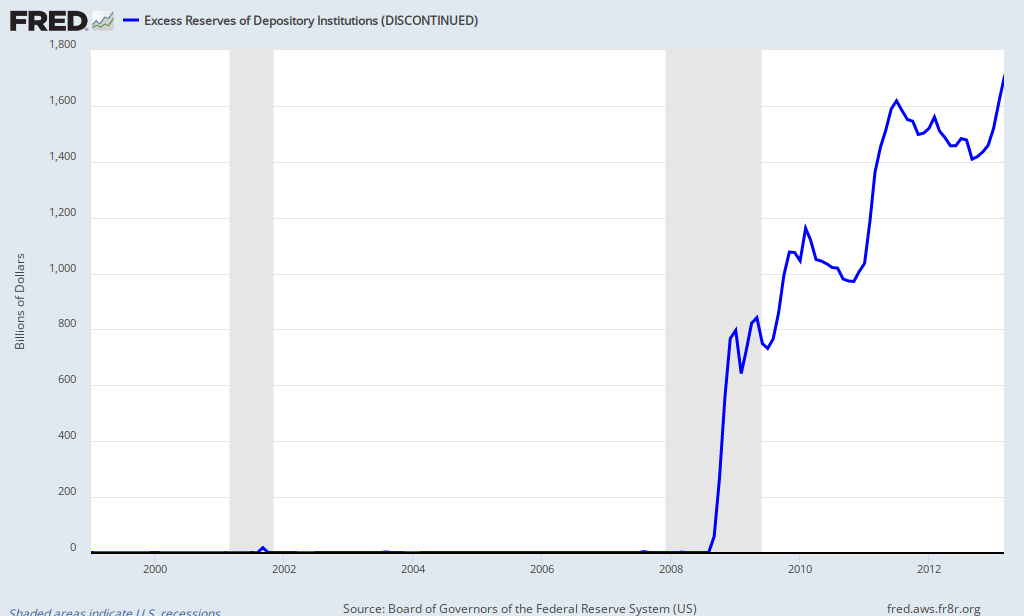
 FRED Graph

Can the tide be turning against the megabanks?

Item: the megabanks continue to strangle the economy by hoading more cash than ever which enables them to continue to trade derivatives with each other but utterly fails to fund credit expansion for growth. The Fed is printing money only to fund the massive quadrillion dollar derivatives casino; this is politically unsustainable.

Item: Recently the G20 identified the 29 megabanks deemed too big to fail globally and not a single one operated to enhance shareholder wealth based upon stock returns; a stunning record of failure of 0-29. In other words, the megabanks cannot justify their existence and should be terminated by the government of their nations ASAP.

Item: Bloomberg recently calculated the profitability of the megabanks in the US and found they make no money after accounting for their subsidized cost of capital. Basically, the taxpayer of the US pays $83 billion per annum to subsidize the megabanks. As I have long contended the megabanks are a leach upon our economy.

Item: Attorney General Eric Holder's absurd testimony of March that some banks (and individuals) are above white collar crime recently backfired in the form of bills to breakup the megabanks--a bill that is supported by two regional Federal Reserve Bank Presidents. There are now two bills pending that seek to end too big to fail.

Item: As anyone could predict, the lawlessness at the center of our economy breeds utter corruption. dre cummings recently noted that market rigging has expanded and it appears likely to me that no market is immune from manipulation by megabanks untethered to legal and capitalist accountability.  The Wall Street Journal recently reported that bankers lubricate this market manipulation with kickbacks and yet further corruption: "Several former brokers and bank traders said they witnessed brokers providing clients with cocaine or prostitutes."

Item: The so-called London Whale trade that cost JP Morgan $6.8 billion apparently led to big wins for a hedge fund called Blue Mountain Capital founded by a former Morgan alum. Further that same hedge fund recently hired the former Chair of Morgan's investment bank. So now we have a revolving door between the shadow banking system and the too big to fail banks whereby losses from government backed banks end up in the pockets of cronies with the ultimate payoffs hidden in the dark reaches of the hedge fund industry. On March 15th, the US Senate released a report that all but accused JP Morgan of securities fraud.

In coming days I will post on where this system formerly known as Western Capitalism is headed. I will post on Cyprus and how depositors and taxpayers ultimately pay when too big to fail banks become too big to bail. I will post on how this system seems destined to end with the confiscation of deposits in the form of negative interest rates or other wealth transfers to the megabanks. I will also post about the entire derivatives scam which have turned the megabanks into piggy banks for the hedge fund industry with the Fed providing funny money for the financial elite to play with.

But the point today is that we need not stand by idly and witness the debauchery of capitalism. Write your representatives and urge them to support this bill.

Monday, April 29, 2013

Everything is Rigged

Price fixing seems to be in vogue for Too Big To Fail megabanks.  Matt Taibbi at Rolling Stone weighs in on the most recent financial collusion amongst the big banks in "Everything is Rigged: The Biggest Price Fixing Scandal Ever."

Taibbi writes: "You may have heard of the Libor scandal, in which at least three - and perhaps as many as 16 - of the name-brand too-big-to-fail banks have been manipulating global interest rates, in the process messing around with the prices of upward of $500 trillion that's trillion, with a "t") worth of financial instruments. When that sprawling con burst into public view last year, it was easily the biggest financial scandal in history - MIT professor Andrew Lo even said it "dwarfs by orders of magnitude any financial scam in the history of markets.

That was bad enough, but now Libor may have a twin brother. Word has leaked out that the London-based firm ICAP, the world's largest broker of interest-rate swaps, is being investigated by American authorities for behavior that sounds eerily reminiscent of the Libor mess. Regulators are looking into whether or not a small group of brokers at ICAP may have worked with up to 15 of the world's largest banks to manipulate ISDAfix, a benchmark number used around the world to calculate the prices of interest-rate swaps.

Interest-rate swaps are a tool used by big cities, major corporations and sovereign governments to manage their debt, and the scale of their use is almost unimaginably massive. It's about a $379 trillion market, meaning that any manipulation would affect a pile of assets about 100 times the size of the United States federal budget. It should surprise no one that among the players implicated in this scheme to fix the prices of interest-rate swaps are the same megabanks - including Barclays, UBS, Bank of America, JPMorgan Chase and the Royal Bank of Scotland - that serve on the Libor panel that sets global interest rates."

Why and how did the manipulation of LIBOR and ICAP take place?  Taibbi answers:  "Dating back perhaps as far as the early Nineties, traders and others inside these banks were sometimes calling up the company geeks responsible for submitting the daily Libor numbers (the "Libor submitters") and asking them to fudge the numbers. Usually, the gimmick was the trader had made a bet on something – a swap, currencies, something – and he wanted the Libor submitter to make the numbers look lower (or, occasionally, higher) to help his bet pay off."

Friday, April 26, 2013

Austerity Bites: The Impact of Spending Cuts on Communities of Color

The University of Utah S.J. Quinney College of Law hosted a symposium in March 2013, entitled "Austerity vs. Growth: Lessons for the U.S. Economy."  While there, Professor Steven Ramirez delivered remarks entitled "Mythological Austerity," which he linked to yesterday.

Linked today is the presentation "Austerity Bites: Communities of Color and the Impact of Spending Cuts."  The argument herein suggests that austerity is never distributed equally across wealth levels.  Particularly, sequestration and austerity always seems to fall hardest and heaviest on those least able to afford it.

Tuesday, April 23, 2013

Bankers Above the Law II: Criminal Affirmance Runs Amok

Professor Mary Ramirez recently posted her University of Connecticut Law Review article on SSRN. It is available for free download.  Here is the abstract:

Recent financial scandals and the relative paucity of criminal prosecutions against elite actors that benefited from the crisis in response suggest a new reality in the criminal law system: some wrongful actors appear to be above the law and immune from criminal prosecution. As such, the criminal prosecutorial system affirms much of the wrongdoing giving rise to the crisis. This leaves the same elites undisturbed at the apex of the financial sector, and creates perverse incentives for any successors. Their incumbency in power results in massive deadweight losses due to the distorted incentives they now face. Further, this undermines the legitimacy of the rule of law and encourages even more lawlessness among the entire population, as the declination of prosecution advertises the profitability of crime. These considerations transcend deterrence as well as retribution as a traditional basis for criminal punishment. Affirmance is far more costly and dangerous with respect to the crimes of powerful elites that control large organizations than can be accounted for under traditional notions of deterrence. Few limits are placed on a prosecutor’s discretionary decision about whom to prosecute, and many factors against prosecution take hold, especially in resource-intensive white collar crime prosecutions. This article asserts that prosecutors should not decline prosecution in these circumstances without considering its potential affirmance of crime. Otherwise, the profitability of crime promises massive future losses.

The article does not include the deeply disturbing testimony of Attorney General Eric Holder that banks and criminals employed by banks are not subject to criminal procecustions on the same basis as ordinary citizens because that absurd testimony is too recent. Still, Holder's admission that some banks and their criminal employees are too big to jail certainly raises the importance and timliness of Professor Mary Ramirez' most recent installment seeking to restore balance to a ridiculously out of whack criminal "justice" system. 

What does it say about a society that rounds up young people of color by the thousands for relatively innocuous behavior while white collar criminals on Wall Street can crash global capitalism and corrupt the pinnacle of our economy with impunity? So much for any post-racial America.

The social construct of race still thrives in America and nowhere is this more obvious than in policies relating to incarceration.

Monday, April 15, 2013

The Re-Education of Barack Obama - Midwestern People of Color Legal Scholarship Conference

The Midwest People of Color Legal Scholarship Conference will be hosted by the Loyola Law School Chicago on April 19-21, 2013, and its theme is "The Re-education of Barack Obama."  After a divisive first term in office, the nation re-elected President Barack Obama despite a deep disaffect felt by both conservatives and progressives.  The Re-education of Barack Obama conference will seek to assess the policy victories and failures in the President's first term and will strive to provide progressive inspiration for second term policies and actions.  Professors and scholars of color from across the country will convene in Chicago and engage in this scholarly debate beginning on Friday, April 19th.

The program details are below:


MIDWESTERN PEOPLE OF COLOR LEGAL SCHOLARSHIP CONFERENCE
MWPOC

The Re-Education of Barack Obama

Loyola University Chicago School of Law
25 East Pearson Street, Chicago, IL

April 18-21, 2013

Schedule of Events

Thursday, April 18th:
6:30-9:00 p.m.  Opening Reception, Loyola University Chicago School of Law
Video, State Senator Barack Obama, 1999 Speech Delivered at Loyola University

Friday, April 19th:
8-8:50 a.m.  Continental Breakfast and Registration
8:50-9:00 a.m.  Welcome, Neil Williams, MWPOC
9:00-10:30 a.m.  Plenary Panel:  National Security and International Relations Policies
10:40 – 12:10 p.m.  Plenary Panel:  The War on Drugs and the Prison Industrial Complex
12:30 p.m.  Lunch
2:00-3:30 p.m.  Plenary Panel:  Capital Markets and Financial Regulation
3:40-5:05 p.m.  Plenary Panel:  Immigration Reform
5:15 – 6:00 p.m.  Concurrent Works in Progress
6:30 p.m. Dinner:  John Hancock Building, Signature Room at the 95th

Saturday, April 20th:
8-9:00 a.m. Continental Breakfast and Registration
9:00-10:30 a.m.  Plenary Panel:  Critical Supreme Court Cases
10:45 – 12:15 p.m.  Plenary Panel:  Effectiveness of the Affordable Care Act (ObamaCare) in
Eliminating Racial Health Disparities
12:30 p.m.  Lunch – Keynote Presentations, Ms. Janet Bell, Reflections on the Legacy of Derrick Bell; Professor Shavar Jeffries
2:00 – 3:30 p.m.  Concurrent Works in Progress
3:45 – 5:15 p.m.  Concurrent Works in Progress
5:30 – 7:00 p.m.  Concurrent Works in Progress
7:00 p.m.  Dinner: On Own

Sunday, April 21st:
9-10:00 a.m.  Continental Breakfast
10:00-12 Noon  Roundtable:  Retrenchment:  Responding to the Law School Crisis
12 noon  MWPOC Business Meeting
1:00 p.m.  Adjourn

Thursday, April 11, 2013

Catching Up On Links . . .

Several important stories have surfaced over the past several weeks, including:

A Failed Whale, And How To Fix It, by Alexis  Goldstein [The Nation]
Jamie Dimon, CEO JP Morgan
Describing JP Morgan CEO Jamie Dimon's role in the "London Whale" scandal that lost JP Morgan billions.  According to Goldstein:  "Even in the wake of the financial crisis, the bailouts and ongoing bank malfeasance, Washington has remained deferential to the financial industry. Regulators parrot the industry's talking points and use them as an excuse to water down important parts of the Dodd-Frank Wall Street Reform and Consumer Protection Act. And congressional representatives on both sides of the aisle continue to introduce bills to slowly gut Dodd-Frank.  What has JPMorgan Chase been doing while Washington is so dutifully doing its bidding? In the words of the stunningly comprehensive [Senate] subcommittee report [on the London Whale scandal], JPMorgan Chase 'manipulated models; dodged OCC oversight; and misinformed investors, regulators, and the public about the nature of its risky derivatives trading.' Lest you think this is all, rest assured that there is more: JPMorgan was also hiding losses and ignoring its own internal warnings that risk was increasing dramatically."

King Cotton's Long Shadow, by Walter Johnson [New York Times]
Answering the question of "What was the role of slavery in American economic development?"  According to Johnson:  "The most familiar answer to that question is: not much. By most accounts, the triumph of freedom and the birth of capitalism are seen as the same thing. The victory of the North over the South in the Civil War represents the victory of capitalism over slavery, of the future over the past, of the factory over the plantation. In actual fact, however, in the years before the Civil War, there was no capitalism without slavery. The two were, in many ways, one and the same."

Who Will Get the Real Mortgage Crisis Profits? by Peter Miller [Ourbroker.com]
Describing the massive profits housing giants Fannie Mae and Freddie Mac received in 2012, and wondering who will ultimately reap these rewards if Fannie Mae and Freddie Mac are privatized.

Inside the Belly of the Beast: Corrections Corporation of America and the Recession, by Hadar Aviram [California Correctional Crisis Blog]
Describing the business model of the private for-profit prison industry, particularly in recessionary times.  According to Aviram:  CCA institutions - of which it operates 67 and owns 49 - are located in 20 states and in DC (6 of their institutions are, at this point, vacant). After an initial period of time, population in its private institutions averages 89%. A minimum occupancy is often, albeit not always, mentioned in its contracts with the states to whom it provides services. The business model is structured around the concept of a "per-diem", that is, the state pays a price per-inmate-per-bed-per-day. . . .  Who are CCA's main customers? Well, the federal government, for one. Revenues from federal clients comprise 43% of CCA's total revenue for the years 2010 and 2011. But of the states that contract with CCA, California is a major contributor, providing CCA with 13% of its management revenue."


[photo courtesy of Steve Jurvetson, via Creative Commons]

Friday, April 5, 2013

GEO Group Stadium Naming Deal Fails

FAU Students Protesting GEO Group Naming Deal
When the GEO Group and Florida Atlantic University agreed to a $6 million football stadium naming deal in February 2013, neither GEO CEO George Zoley or FAU President Mary Saunders anticipated the incredible backlash that descended upon the private for-profit prison company (GEO) and the University.  Due to student protests, faculty opposition, national media attention being drawn to GEO's terrible record of human rights violations in its private prisons, and the quickly assigned nickname of "Owlcatraz" to the FAU Owls football stadium, GEO Group announced yesterday that it was withdrawing its pledged stadium naming donation.  In pulling its $6 million pledge, CEO Zoley released a self-serving statement blaming "distractions" as the reason that the pledge was being withdrawn.  Per Zoley:  "What was originally intended as a gesture of GEO's goodwill to financially assist the University's athletic scholarship program has surprisingly evolved into an ongoing distraction to both of our organizations."

The "surprising[] . . . distractions" to which Zoley refers include (a) student protests challenging FAU to reject the donation as hypocritical pointing out that GEO Group's profit base is derived almost entirely from human misery and suffering, (b) an overwhelmingly passed faculty resolution calling upon President Saunders to cancel the deal because GEO Group's "business practices do not align with the mission of the university," (c) a sit-in held in President Saunder's office by students, (d) a mocking national spotlight from Stephen Colbert's comedy/news show (suggesting that one of the problems of drawing attention to your business, is that people will pay attention to what your business actually does), and (e) community outrage protesting GEO's intimate affiliation with an institution of higher education.

As has been discussed in this blog space often, private prison companies are perversely incentivized to generate profit based on human misery through working to increase the incarceration levels of United States citizens and immigrants.  Private prison corporations pay dozens of millions of dollars to lobby legislators for harsher sentencing regimes, new crimes that require incarceration (AZ SB1070), and increasing prevalence of private prison contracts based on dubious claims of efficiency and cost savings.  Without providing any product or needed public good, GEO Group, the Corrections Corporation of America (CCA), and other private prison companies profit in two primary ways that are incredibly objectionable:

First, private prison companies contract with state and federal governments to warehouse U.S. prisoners and are paid in taxpayer funds on a "per bed" basis.  Essentially, taxpayer funds are being transferred from taxpaying citizens into the pockets of private prison company executives and shareholders for no recognizable good or service.  Almost all of the recent emerging evidence suggests that private prison companies run prisons LESS efficiently, LESS safely, and LESS cost effectively than do federal and state governments.  The Lake Erie Prison report just released finds that CCA is so profit driven, that the CCA- run prison at Lake Erie does not provide proper supervision of prisoners and that drug use and violence are rampant, both in an attempt to avoid costly prisoner lawsuits. 

Second, private prison companies exploit the labor of the prisoners in their care by entering into contracts with companies like IBM, Victoria's Secret, WalMart, and McDonald's for prisoners to work for pennies with the contractual rewards paid into the coffers of the private prison company (thus to shareholders and executives).  Prisoners are paid between $0 and $4 for the labor that they engage in sewing for Victoria's Secret, manufacturing for WalMart and McDonalds, with the fruit of their labor being paid to the prison company rather than to the prisoner.  Indentured servitude continues in our prisons in the United States and the GEO Group and CCA profit from these immoral activites.

Rendering of how GEO Group Stadium would have appeared
That both of these profit sources continue in the United States today is shocking.  That the students, faculty, and community at FAU recognized this appalling business model is heartening. The GEO Group's name will NOT adorn the football stadium at FAU.  It appears that "surprising[] . . . distractions" of massive protest are just beginning for the private prison industry.


 cross-posted on the Sports Law Blog