Monday, December 30, 2013

Important Stories to Close Out the Year

As 2013 draws to a close, two important events have occurred in December that bear mentioning as the world prepares to usher in 2014.  In connection with America's epic failure, the War on Drugs:

First, A Divided Federal Court Rules Crack Cocaine Sentencing Reforms Do No Apply to Those Already in Prison:
In a blow to those sentenced under grossly unfair crack cocaine versus powder cocaine sentencing requirements, the Sixth Circuit Court of Appeals ruled in early December that the new sentencing regime ushered in under the 2010 Fair Sentencing Act does not apply retroactively to those currently sitting in prison.  From the NAACP release: "[A] sharply divided Sixth Circuit Court of Appeals ruled that the Fair Sentencing Act (FSA), which reduced the unfair, unjustified, and racially discriminatory crack cocaine/powder cocaine sentencing ratio from 100-to-1 to 18-to-1, does not apply to thousands of individuals who are currently incarcerated pursuant to sentences imposed under the discredited 100-to-1 regime.  Seven judges concluded that the FSA should apply to those serving sentences under the 100-to-1 federal sentencing structure, and ten judges declared that it should not."

"'We are deeply disappointed in the outcome of this case. Thousands of people, the majority of whom are African-American, are still serving time under an unfair drug sentencing regime that has destroyed individuals, families and communities. Today’s decision demonstrates that those who are working to eliminate the impermissible role of race in criminal prosecutions and sentences still have much more work to do. We will continue to press this issue in the court,' said Sherrilyn A. Ifill, President and Director-Counsel of the NAACP Legal Defense and Educational Fund, Inc., a leading civil rights law firm and a separate entity from the NAACP."

President Obama, Congress, Federal Courts, and the United States Supreme Court must act immediately to  begin commuting the sentences of those individuals imprisoned under the grossly unfair 100:1 sentencing disparity between crack and powder cocaine.

Second, President Obama Commutes the Sentences of Eight Crack Cocaine Offenders:
President Obama, recognizing that thousands of inmates are jailed under patently unfair sentencing policies in connection with crack cocaine and powder cocaine sentences, began what can fairly be hoped for as the beginning of righting past wrongs, commuted the sentences of eight crack cocaine offenders who have served prison time for more than 15 years, and would be out of prison, had they been sentenced under powder cocaine guidelines.

Congress passed the Fair Sentencing Act in 2010 which, according to The Root, "reduced the disparity in sentencing between offenses for crack and powder cocaine from 100:1 to 18:1. The 100:1 ratio meant that people involved in offenses for crack cocaine faced longer sentences that those involving the same amount of powder cocaine."  The New York Times reports that President Obama released the following statement: 

"'This law began to right a decades-old injustice, but for thousands of inmates, it came too late,' the president said in a release given to the media. 'If they had been sentenced under the current law, many of them would have already served their time and paid their debt to society.  Instead, because of a disparity in the law that is now recognized as unjust, they remain in prison, separated from their families and their communities, at a cost of millions of taxpayer dollars each year.'"

Let's hope for much more of the same in 2014.

Sunday, December 29, 2013

Volcker Rule Melting Fast

The almost toothless Volcker Rule imposed earlier this month seems poised to be further defanged. Apparently some banks hold a certain type of CDO that is not permitted under the new rule. They do not have to dispose of it anytime soon, mind you, but they can no longer pretend that they intend to hold it to maturity. That means it must be marked to market. Banks therefore must recognize losses and take hits to capital. Thus, Zions Bank recognized a $387 million loss on CDOs it previously marked at cost but now must be marked to market due to the fact that sooner or later (especially later) they may not be able to continue holding such securities in the future. Apparently many banks are in the same position as Zions and they too would rather not acknowledge their market losses.

I would argue the rule is actually beneficial here. Accounting rules should reflect reality not fantasy. The market losses are real and these securities would not be valued so low if they were safe and would pay-off in due cross. Losses also signal to banks that they cannot escape accountability for poor investment decisions by pretending the losses do not exist.

But, the American Bankers Association would have none of it and sued to challenge the rule. Given the natural proclivities of the judicial system in favor of the most wealthy and powerful (who can afford to hire hoards of lawyers) a judicial challenge to the Volcker Rule in not likely to result in an economically sound ruling.

Worse, however, it appears the regulators simply intend to fold. They recently announced that they intend to  review the rule in light of the ABA's complaint.

Wednesday, December 11, 2013

Volcker Rule: Still Much Ado About Nothing

So a few days after Dodd-Frank became law I posited that the so-called Volcker Rule would do little to solve excessive speculation by banks subsidized by the federal government through deposit insurance, or otherwise. Here is what I said then.

Yesterday, the Fed released its final rules on the Volcker Rule. Compare their release with my summary from 2010, here.

The bottom line is that megabanks may still engage in all kinds of speculative activities. Here is the money quote from the Fed:  "Like the Dodd-Frank Act, the final rules provide exemptions for certain activities, including market making, underwriting, hedging, trading in government obligations, insurance company activities, and organizing and offering hedge funds or private equity funds. The final rules also clarify that certain activities are not prohibited, including acting as agent, broker, or custodian." In other words the megabanks can be investment banks with government backing.

The rules take effect July 21, 2015. This can be extended by the Fed.

Frankly, I cannot see how these rules change anything. More to come. . .

Saturday, November 30, 2013

The Leading Subprime Lenders Most Responsible for the Mortgage Meltdown

As promised, below is the 2009 list of the top 25 subprime lenders that crushed the U.S. housing market in 2007-08.  As discussed earlier this week, nearly every executive at the below banks have more than landed on their feet and are now reengaged in the business of writing loans . . .

Courtesy of The Center for Public Integrity:

"These top 25 lenders were responsible for nearly $1 trillion of subprime loans, according to a Center for Public Integrity analysis of 7.2 million “high interest” loans made from 2005 through 2007. Together, the companies account for about 72 percent of high-priced loans reported to the government at the peak of the subprime market. Securities created from subprime loans have been blamed for the economic collapse from which the world’s economies have yet to recover.
  1. Countrywide Financial Corp.
    Amount of Subprime Loans: At least $97.2 billion
  2. Ameriquest Mortgage Co./ACC Capital Holdings Corp.
    Amount of Subprime Loans: At least $80.6 billion
  3. New Century Financial Corp.
    Amount of Subprime Loans: At least $75.9 billion
  4. First Franklin Corp./National City Corp./Merrill Lynch & Co.
    Amount of Subprime Loans: At least $68 billion
  5. Long Beach Mortgage Co./Washington Mutual
    Amount of Subprime Loans: At least $65.2 billion
  6. Option One Mortgage Corp./H&R Block Inc.
    Amount of Subprime Loans: At least $64.7 billion
  7. Fremont Investment & Loan/Fremont General Corp.
    Amount of Subprime Loans: At least $61.7 billion
  8. Wells Fargo Financial/Wells Fargo & Co.
    Amount of Subprime Loans: At least $51.8 billion
  9. HSBC Finance Corp./HSBC Holdings plc
    Amount of Subprime Loans: At least $50.3 billion ***
  10. WMC Mortgage Corp./General Electric Co.
    Amount of Subprime Loans: At least $49.6 billion
  11. BNC Mortgage Inc./Lehman Brothers
    Amount of Subprime Loans: At least $47.6 billion ***
  12. Chase Home Finance/JPMorgan Chase & Co.
    Amount of Subprime Loans: At least $30 billion
  13. Accredited Home Lenders Inc./Lone Star Funds V
    Amount of Subprime Loans: At least $29.0 billion
  14. IndyMac Bancorp, Inc.
    Amount of Subprime Loans: At least $26.4 billion
  15. CitiFinancial / Citigroup Inc.
    Amount of Subprime Loans: At least $26.3 billion
  16. EquiFirst Corp./Regions Financial Corp./Barclays Bank plc
    Amount of Subprime Loans: At least $24.4 billion
  17. Encore Credit Corp./ ECC Capital Corp./Bear Stearns Cos. Inc.
    Amount of Subprime Loans: At least $22.3 billion
  18. American General Finance Inc./American International Group Inc. (AIG)
    Amount of Subprime Loans: At least $21.8 billion ***
  19. Wachovia Corp.
    Amount of Subprime Loans: At least $17.6 billion.
  20. GMAC LLC/Cerberus Capital Management
    Amount of Subprime Loans: At least $17.2 billion ***
  21. NovaStar Financial Inc.
    Amount of Subprime Loans: At least $16 billion
  22. American Home Mortgage Investment Corp.
    Amount of Subprime Loans: At least $15.3 billion
  23. GreenPoint Mortgage Funding Inc./Capital One Financial Corp.
    Amount of Subprime Loans: At least $13.1 billion
  24. ResMAE Mortgage Corp./Citadel Investment Group
    Amount of Subprime Loans: At least $13 billion
  25. Aegis Mortgage Corp./Cerberus Capital Management
    Amount of Subprime Loans: At least $11.5 billion
***Total includes subsidiaries"

Tuesday, November 26, 2013

Checking Back In On the Mortgage Crisis Perpetrators

Five years after the collapse of Lehman Brothers which ushered in the crushing mortgage crisis of 2008, perpetuated primarily by subprime lenders, it appears that those most at fault for originating, selling and packaging predatory subprime loans are fully back in business.  Most now agree that lowered lending standards, predatory loans, and an insatiable Wall Street appetite for packaging loans into investment instruments, all at massive profit margins, led to the 2007-08 implosion of global markets.  Now, those individuals most responsible for creating the reckless loans that enabled the crisis have reentered the lending market after facing next to no genuine discipline for their recklessness.

According to The Center for Public Integrity's report Subprime Lending Execs Back in Business Five Years After Crash: "Five years after the financial crisis crested with the bankruptcy of Lehman Brothers Holdings Inc., top executives from the biggest subprime lenders are back in the game. Many are developing new loans that target borrowers with low credit scores and small down payments, pushing the limits of tighter lending standards that have prevailed since the crisis.  Some experts fear they won’t know where to stop.

The Center for Public Integrity in 2009 identified the top 25 lenders by subprime loan production from 2005 through 2007. Today, senior executives from all 25 of those companies or companies that they swallowed up before the crash are back in the mortgage business. Most of these newer “non-bank” lenders are making or collecting on loans that may be too risky to qualify for backing by the U.S. government. As the industry regains its footing, these specialty lenders represent a small but growing portion of the market."

As always seems to be the case when financial fraud and debauchery are involved, U.S. citizens continue to struggle economically, as foreclosures and joblessness continues, meanwhile, banking executives that engaged in the reckless lending that led to the market collapse are back at it with very little meaningful or realistic consequences. Later this week, I will post the list of the top 25 subprime lenders from 2005 to 2007, whose executives are now fully re-engaged in the loan business.

Wednesday, November 20, 2013

Occupy Wall Street-Where Did You Go?: The Widening American Wealth Gap

I just ran across a thought provoking article on CNN-Money entitled the "Split Economy."  The article reminds us that "[t]he divide between the 'haves and the 'have-nots' has never been greater."  "And every day brings a reminder of the rich making and spending huge sums of money  while the poor struggle to support their basic needs."  The article juxtaposes examples of wealth and conspicuous consumption against images of dire poverty in our country.  Here go examples:

  • Dow 16,000-Stock market hits all-time high - 46.5 million Americans still living in poverty;

  • Painting fetches record $142.4 million in auction - 47.5 million need food stamps to buy groceries;

  • Twitter IPO created 3 billionaires - On the same day, 5 Wal-Mart workers arrested while striking for higher pay;

  • NYC apartment listed for $125 million - A record 1.2 K-12 students are homeless;

  • Lamborghini Veneno goes on sale for $4.5 million - Public transportation fare hikes across the US. 
This just makes me ask-Occupy Wall Street-Where did you go?  At least the Occupy Wall Street Movement kept the woes of the 99% in the news for a while.  Today, it is easy to become complacent and detached and forget to look around and spot the issues that are plaguing our society.  This article was food for thought.  I hope you find it thought provoking as well.   

Thursday, November 7, 2013

Hedge Fund Giant SAC Capital Pleds Guilty to Criminal Insider Trading Charges

Hedge fund giant SAC Capital pled this week to criminal insider trading charges leveled by the Securities and Exchange Commission ("SEC").  As part of the plea deal, SAC Capital agreed to pay a record $1.8 billion fine for engaging in insider trading.  Additionally, prosecutors announced that SAC Capital will shatter it's investment advisory business--in essence ending the hedge funds ability to manage money for outside investors.  This does not mean that SAC Capital is dead.  The plea deal still allows SAC Capital's founder, billionaire Steve Cohen, to operate the firm as a "family office," to invest  Cohen's and other SAC Capital insider's own money. 

Cohen is one of the nation's most high flying hedge fund managers.  Cohen has an estimated net worth of $9.4 billion.  It remains an open question as to whether or not the SEC plans to bring criminal insider trading charges against Cohen.  Cohen is facing civil liability in connection with civil charges the SEC brought against him in July, for failing to supervise employees engaged in insider trading. 

Federal prosecutors alleged that SAC Capital engendered a institutional culture of blatant insider trading "that was substantial, pervasive, and on a scale without precedent."  A number of instant messages and emails among SAC Capital traders suggested and insinuated that these traders had obtained illicit inside information from corporate insiders.

SAC Capital's legal troubles have had an impact on investors.  as of January 1, 2013, SAC Capital managed $15 billion in assets, today the firm only manages approximately $9 billion in assets, mostly all of which belongs to Cohen and other employees.  SAC Capital's legal troubles are not new.  In March of 2013, SAC Capital agreed to pay $616 million to settle allegations of insider trading in a separate SEC initiated civil action.  Monday's plea deal will count this earlier amount paid in settlement of the civil charges-SAC Capital will have to come up with an additional $1.2 billion to settle the criminal charges.    

Wednesday, October 30, 2013

Tea Party Devastation to US Mounts


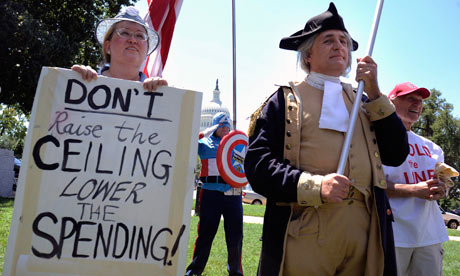
Tea Party debt protest The Tea Party's campaign to permanently disable the US government inflicted a massive toll on the US economy, according to a series of recent reports. Let's start with consumer confidence:


U.S. consumer confidence fell sharply in October as Americans reacted to the Congressional impasse over the debt ceiling and 16-day partial government shutdown earlier this month, according to a survey released Tuesday by The Conference Board. The independent research firm reported the index fell more than expected to 71.2 from 80.2 in September. Economists surveyed by Bloomberg expected an October figure of 75. Those expecting business conditions to improve over the next six months fell to 16 percent from 20.6 percent. The drop in confidence was the biggest decline since August 2011, when lawmakers were also battling to reach a budget deal and threatening a government shutdown.

Consumer confidence plays a key role in macroeconomic performance as a loss of confidence leads to less spending on everything from Halloween to tourism which in turn chills jobs growth and constricts employment opportunities.

The loss in jobs was manifest today in the latest payroll report, as reported by economist Mark Zandi:

The government shutdown and debt limit brinksmanship hurt the already softening job market in October. Average monthly growth has fallen below 150,000. Any further weakening would signal rising unemployment. The weaker job growth is evident across most industries and company sizes.

As recently as April, the economy was creating 224,000 jobs per month. Essentially, the Tea Party leadership is now tossing over 75,000 American families under the bus for no apparent reason. Job growth already suffered from the sequestration cuts demanded by the Tea Party in 2011--by as much as a million jobs per year.

The bottom line is that the Tea Party leadership inflicted massive economic damage on the US economy through its constant flirtation with default. According to a USA Today survey of 41 top economists the tab is likely to amount to $27 billion over the next six months--from the most recent budget battle alone.

I am slowly coming to the conclusion that many Tea Party leaders hate America through their actions regardless of their words. Mainstream GOP voices increasingly recognize the damage the Tea Party is inflicting. As longtime GOP supporter and Home Depot founder Ken Langone asked a GOP House member: "What the hell did you guys gain by shutting the government down other than to get a black eye for all of us?" The response from House Republican Policy Committee Chairman James Lankford of Oklahoma: "I would agree. We got a black eye on it. The problem that we have is we overreached."

Saturday, October 26, 2013

JP Morgan's Settlement of Duplicity Charges

Yesterday, JP Morgan Chase agreed to settle claims that it sold toxic mortgages to government-sponsored enterprises Fannie Mae and Freddie Mac by misrepresenting the quality of the mortgages that it sold to the GSE's during the run-up to the financial market crisis.  JP Morgan agreed to pay $5.1 billion dollars to Fannie Mae and Freddie Mac disclaiming wrongdoing but adding to a rough year of controversy for the Wall Street banking giant.

According to CNN/Money: "The claims relate to conduct at JPMorgan and at Bear Stearns and Washington Mutual, which JPMorgan purchased in 2008. At issue are allegations that the firms sold risky mortgages and mortgage securities while misrepresenting their quality. Among the purchasers were Fannie Mae and Freddie Mac, the government-backed housing finance giants that required a massive bailout in 2008 when their housing investments soured. The deal was announced by the Federal Housing Finance Agency, which has overseen Fannie and Freddie since their 2008 rescue. . . .

JPMorgan will pay $4 billion to resolve claims related to the alleged misrepresentation of mortgage-backed securities - investment products created by bundling payments from individual loans. It will also repurchase $1.1 billion worth of mortgages sold to Fannie and Freddie between 2000 and 2008 that the firms say do not meet their quality standards."

According to Bloomberg:  "The [Federal Housing Finance Authority] had accused JPMorgan and its affiliates of making false statements and omitting material facts in selling about $33 billion in mortgage bonds to the two companies [Fannie and Freddie] from Sept. 7, 2005, through Sept. 19, 2007.  Executives at JPMorgan, Washington Mutual and Bear Stearns Cos., which was also acquired by JPMorgan in 2008, knowingly misrepresented the quality of the loans underlying the bonds, the regulator wrote in the lawsuit in federal court in Manhattan."

Interestingly, in the early post-market crash days, when individuals were rushing to place blame, a clear vocal minority attempted to place full blame for the mortgage crisis on Fannie Mae and Freddie Mac basically arguing that the GSE's created an environment where mortgages of all sizes and shapes would be repurchased by the GSE's, sans standards.  Now, with JP Morgan agreeing to buy back over $1 billion in mortgages and mortgage-backed securities that it misrepresented to the GSE's in the first place, it appears clear that the quality of mortgages sold to the housing giants were fraudulently misrepresented, as historic standards existed for the GSE's in what types of mortgages it would actually purchase from private banks.  Fraud, essentially, was engaged in by Wall Street and commercial banks like Washington Mutual, Countrywide, JP Morgan, Bear Stearns, etc., leading in part to the mortgage crisis that continues to hinder economic growth today.

Despite engaging in alleged fraud, $5.1 billion represents just a fraction of JP Morgan's profits.  "JPMorgan is large enough to easily absorb the settlement costs. It's the biggest bank in the nation, with assets of $2.5 trillion and net income of $21.3 billion in 2012."  That said, "[t]he bank has been buffeted by legal problems in the past few months, however. It has paid over $1 billion in fines in connection with last year's 'London Whale' trading debacle, and $80 million more over its allegedly unfair credit card billing practices."

Thursday, October 24, 2013

What the GOP Says About the Tea Party

In recent posts, I showed the totally unnecessary costs of flirting with default, I gave kudos to responsible GOP leaders, and I laid out the overwhelming expert opinion that the Tea Party's flirtation with default and forced government shutdown was unpatriotic and un-American, as well as damaging to our economy and the national defense. Mainstream voters increasingly see all of this. Thus, a poll released Tuesday night by CNN/ORC International found that the disapproval rate of voters regarding the Tea Party Movement hit a record high of 56%. Only 28% of voters view the movement positively.

Here is Senator John McCain's summary of the effort to defund Obamacare thru a shutdown and the threat of default: “It was a fool’s errand. We inflicted pain on the American people that was totally unnecessary. We cannot do this again. . . . We, Republicans, have a hole that we've got to come out of and obviously we're going to have to do a lot of work."

Senator McCain is hardly alone among GOP elder statesmen who have condemned the Tea Party's tactics. Former GOP chair and former Governor of Alabama Haley Barbour agreed with McCain regarding the whole Tea Party concept of insisting on legislation not otherwise attainable through ordinary processes under the Constitution: "It never had a chance." Former GOP Governor of New Hampshire and former White House Chief of Staff John Sununu blamed the shutdown on the Tea Party and Senator Ted Cruz, telling the AP that: "It's time for someone to act like a grown-up in this process."


Senator Orrin Hatch echoes these views:  "Let’s face it: it was not a good maneuver and that’s when you’ve got to have the adults running the thing.” Former Florida Governor Jeb Bush told Senator Ted Cruz, a Tea Party leader, that he should "have a little bit of self-restraint."

These statements from leaders of the GOP that the leaders of the Tea Party have proven themselves foolish, immature and unrestrained echo my own analysis that the leaders of the Tea Party are unfit to govern (from its incipiency). A broad consensus of the political spectrum has now reached that conclusion. Tea Party support is down to 28%. The movement, however, still poses a grave danger to the US and the American economy. Indeed, since the fall of the Soviet Union, only the war on terrorism exceeded the danger posed to our economy, our government and our way of life than the Tea Party's willingness to allow a default on our debt and the disabling of our government.

Saturday, October 19, 2013

Is the Tea Party Fit to Govern?


In order to lead in a democracy, representatives must comprehend the consequences of their actions, respect democratic processes and not recklessly or intentionally disable the government from functioning in accordance with the wishes of the people. The US Government is the United States of America and its operation is a direct reflection of the democratic wishes of its people as expressed (albeit imperfectly) in our elected leaders. When one speaks of loving America and patriotism, those ideals cannot be divorced from the government. True patriots are willing to make supreme sacrifices on behalf of their fellow citizens and in support of their government.


The best analysis of the fiscal position of the US government immediately prior to October 17, 2013 (when the government would have hit the debt ceiling without the intervention of responsible leadership on both sides of the aisle) shows that the US government would not be able to pay its legal obligations as early as October 22, 2013. After that the US would pile up more and more unpaid legal obligations. Failure to pay legal obligations is a default--whether it is the mortgage payment or the credit cards. It is no different for the government. The default on one legal obligation calls all other legal obligations into question. That is why major holders of US debt assumed such a aggressive position in asserting that the US must pay its lawful obligations and not pick and choose which creditors to pay. US obligations used to be a zero risk instrument; now we must pay more because partisan politics impedes the ability of the government to make payments on its lawful obligations. If the US misses payments the value of all its obligations decline--that is basic finance and an iron rule of market discipline. Call it Economic Logic 101.

But even if that problem could be overcome (and it cannot), it appears that the US Treasury is literally not wired for a selective default: "The Treasury Department maintains that it has no ability to pick and choose which bills to pay if it's short of cash. According to the agency's inspector general, its computer systems are designed to 'make each payment in the order it comes due.'" Thus, there was never any real possibility of selective default, logically or administratively.

Further, there is no legal basis for prioritizing same payments over others.  The law treats all obligations as legally binding. So, even if the Treasury could prioritize payments, because Congress has issued no legal direction on how to allocate funds, President Obama would be forced to break some laws, or ignore the debt ceiling limit to comply with more laws, a Constitutionally impossible position. Further, he would apparently enjoy unbridled discretion and power over the allocation of revenues among lawful obligations. Either way the utter lawlessness of this approach and the massive power transfer to the President apparently never dawned on the Tea Party leaders who led us into this (now imaginary) nightmare. After October 17, our constitutional democracy was doomed, as was our economy.

Yet, 18 GOP Senators and 144 GOP Representatives voted against raising the debt ceiling late on October 16. Did they intend to force Obama into unconstitutional acts so that they could impeach him? Did they want a constitutional crisis? Did it occur to them that our creditors would lose confidence in our obligations and that we no longer would be able to issue zero risk securities? Did they understand the costly consequences of continuing down the road to default?

The sad truth is that the Tea Party leadership was clueless at best. Here are some examples:

"You’re seeing the tremor before the tsunami here. I’m not going to raise the debt ceiling. I think we need to have that moment where we realize [we’re] going broke. I think, personally, it would bring stability to the world markets."  Ted Yoho, Tea Party Rep. from Fla.

"We have 10 times as much tax revenue as we've got annual interest on the debt obligations. So if the president does not want us to default on our credit or obligations, we won't." Mo Brooks, Tea Party Rep. from Alabama.

"I'm not as concerned as the president is on the debt ceiling, because the only people buying our bonds right now is the Federal Reserve. So it's like scaring ourselves." Richard Burr, Tea Party Senator from NC.

"If you don't raise your debt ceiling, all you're saying is, 'We're going to be balancing our budget.' So if you put it in those terms, all these scary terms of, 'Oh my goodness, the world's going to end' — if we balance the budget, the world's going to end? Why don't we spend what comes in?"  Rand Paul, Tea Party Senator from Ky.

"CNN’s Erin Burnett: You would be willing to make cuts, I want to make it clear, to entitlements, things like Medicare, that’s what you’re asking for [in order to raise the debt ceiling and avoid default]?
GOP/Tea Party’s Tim Huelskamp: We have had those votes, we’ve had those votes on numerous things, yes I will." Tea Party Rep. from Kan. (Interview with Erin Burnett).

These quotes demonstrate a complete lack of appreciation for democratic lawmaking under our constitution as well as basic principles of finance and economics. For example, the Federal Reserve simply is not the exclusive investor in Treasury debt and in no way would a default enhance stability in global financial markets. Similarly, imposing a balanced budget mandate in the face of a default would disable our nation in lasting ways that would be against the overwhelming majority of voters. Thinking otherwise is akin to believing in the tooth fairy or the Easter bunny.

Further, entitlement reform is necessary for long term budget sustainability. But, insisting upon either entitlement reform or default is contrary to all notions of democratic governance and completely contrary to the Constitution. If all politicians behaved this way democratic rule making would cease, our government would cease to function, and we would be in constant economic depressions. Defaults would become endemic to the system to maintain credibility behind the constant threat of default. Extreme conservatives should consider the patent irresponsibility if the Democrats insisted on default in exchange for the passage of Cap and Trade for carbon emissions.

Plainly, we cannot allow our system of government to devolve into political and economic terrorism. Otherwise, we all end up less prosperous, more impoverished and consigned to constant state of economic pain and misery. This is not the American tradition and this is not what made our nation great. Our common commitment to each other and democratic lawmaking necessarily imposes limits on the extreme measures we can permit for partisan advantage.

For these reasons, many of the leaders of the Tea Party (certainly those quoted above) simply have no right to continue in Congress. They are not fit to govern. Responsible elements of our political system must work for the defeat of those who share ideas like those expressed above and those who would otherwise resort to default as a tool of political advantage.

Friday, October 18, 2013

Benefit Corporations: New Indiana Law Review Article Explains and Explores the Virtues of Benefit Corporations

Recently, my article entitled "When Making Money and Making a Sustainable and Societal Difference Collide: Will Benefit Corporations Succeed or Fail?" appeared in Volume 46:3 of the Indiana Law Review.  To my knowledge, this is one of the first articles to examine the "benefit corporation" a new form of organization that is a recent legislative creation, existing in a handful of states.  I believe that benefit corporations hold a great deal of promise for socially-minded entrepreneurs.  I'm placing a link to the article on my SSRN page, and encourage you to download and review this article.  Below is a brief abstract of the article: 

  • A quiet, but important, corporate revolution is afoot in the United States. Many of us, laypersons and corporate scholars alike, have not even noticed. A new type of corporate entity has been created-the benefit corporation.
  • This article explores benefit corporations as a tool entrepreneurs can use to make money, foster environmental sustainability, and create societal improvement. Part I briefly examines who has been advocating for the creation and passage of benefit corporation legislation in the United States. Part II analyzes the statutory requirements to form a benefit corporation. Specifically, Part II discusses the issues of purpose, accountability, transparency, rights of action, and enforcement of those rights in connection with the creation and operation of a benefit corporation. Part III highlights the states that have passed benefit corporation statutes and highlights those considering similar legislation. Part IV examines the pre-existing use of benefit entities, in unincorporated form, through exploration of the benefit certification process. Finally, Part V offers a future prognosis and debates whether benefit corporations will succeed or fail.

http://papers.ssrn.com/sol3/papers.cfm?abstract_id=2338140

The Utter Recklessness (and Worse) of Default

In my last post, I commended the 144 GOP Representatives who voted against default as well as the 24 GOP Senators who joined against default. I also commended the Business Roundtable for its farsighted stand against default.

But, one wonders why the option of default even became an issue. Virtually all experts agree that a default of the US Government would mean an economic cataclysm. For example:

"If there is that degree of disruption, that lack of certainty, that lack of trust in the US signature, it would mean massive disruption the world over and we would be at risk of tipping yet again into recession." IMF Managing Director, Christine Lagarde.

"Inaction could result in interest rates rising, confidence falling and growth slowing. . . . if default comes to pass it would be a disastrous event for the developing world and that will in turn greatly hurt the developed economies as well." World Bank President, Jim Yong Kim.

"The point is that with each passing day the debt limit is not increased the more damage it will do to our economy. If lawmakers don’t raise the debt limit by November 1, the economy will fall back into recession. If they can't raise it by the end of November, we will be dooming our economy and the entire global economy to a wrenching economic downturn with implications for years if not decades to come." Former Economic Adviser, McCain-Palin Campaign and Chief Economist, Moody's Analytics, Mark Zandi.

"It's very hard to see a silver lining. . . . It's a constitutional breakdown, [and] threatening financial Armageddon is blackmail. . . . A good guess is that it would be worse than you think." Former McCain Adviser and Harvard Economist Kenneth Rogoff.

"What sane people should be emphasizing is that in addition to the risk of financial disruption, there’s the certainty of huge pain from spending cuts and a crippling hit to economic growth." Nobel laureate Paul Krugman.

“If we miss an interest payment, that would blow Lehman out of the water. Lehman was an isolated company, and now we are talking about the U.S. government.” Former Bush Administration Official and Managing Director, BNP Paribus, Tim Bitsberger.

So, it is fair to say that with near unanimity economists and financial experts use terms like insane or Armageddon or catastrophic to describe the financial consequences of default. One thoughtful analysis of the risk of default by Nobel laureate Michael Spence demonstrates the loss of global economic clout. He states that "the long-run effects of the US default threat will be overwhelmingly negative," endangering our global economic leadership and international leadership.
The long-run effects of the US default threat will be overwhelmingly negative
Read more at http://www.project-syndicate.org/commentary/on-the-price-of-us-political-dysfunction-by-michael-spence#Cu3xzIWv1fJMpgcB.99
The long-run effects of the US default threat will be overwhelmingly negativ
Read more at http://www.project-syndicate.org/commentary/on-the-price-of-us-political-dysfunction-by-michael-spence#Cu3xzIWv1fJMpgcB.99
The long-run effects of the US default threat will be overwhelmingly negativ
Read more at http://www.project-syndicate.org/commentary/on-the-price-of-us-political-dysfunction-by-michael-spence#Cu3xzIWv1fJMpgcB.99

But, there are even more consequences of a default. For example, the Director of National Intelligence testified that the government shutdown degraded US intelligence capabilities and made a terrorist attack more likely. Fareed Zakaria reported that the shutdown comforted Al-Qaeda and encouraged them to launch more attacks to bleed us economically. The Army Chief of Staff, General Ray Ordierno, stated that "[t]he longer [the shutdown] goes on, the worse it gets. Every day that goes by, we are losing manpower, we are losing capability, so in my mind it is important we get this resolved."

Some claim the threat of default is treasonous. Given the patent costs and dangers implicit in the shutdown and the threatened default, one naturally wonders if these tactics constitutes treason. Most likely, it falls just short of treason. According to the United States Constitution, Article III, § 3: “Treason against the United States, shall consist only in levying war against them, or in adhering to their Enemies, giving them Aid and Comfort. No Person shall be convicted of Treason unless on the Testimony of two Witnesses to the same overt Act.” Voting to defund the US government or to allow a default  is certainly weakening our national defense, our anti-terrorist efforts, our economy and rendering indirect aid to our enemies. But there was no adhering to our enemies or any apparent intent to aid our enemies. If Congress declares war then certainly the refusal to raise the debt limit would be treasonous, but Congress has not declared war.

Nevertheless, this threatened default was the most anti-American and unpatriotic attack on our government and national security I have seen in my lifetime, short of war. In my next post I will spotlight specific individuals and so-called leaders who acted with the highest degree of recklessness and irresponsibility.

Thursday, October 17, 2013

Responsible Leadership Averts Default


My last post on the debt debacle showed that as a result of extreme politics regarding the debt limit and funding the government the US economy: 1) has lost $150 billion in foregone output; 2) suffered employment losses totaling 900,000 jobs; and 3) must now pay up to $15 billion in additional interest payments per annum on our debt. Why?

Well, its hard to get a better source than the credit rating agencies. The Fitch credit rating agency put the US on negative watch on October 15, 2013 for "political brinksmanship" on the budget and debt limit. Here is the direct quote from Fitch regarding the primary reason for its action:

"The U.S. authorities have not raised the federal debt ceiling in a timely manner before the Treasury exhausts extraordinary measures. The U.S. Treasury Secretary has said that extraordinary measures will be exhausted by 17 October, leaving cash reserves of just USD30bn. Although Fitch continues to believe that the debt ceiling will be raised soon, the political brinkmanship and reduced financing flexibility could increase the risk of a U.S. default."

This harkens back to the Standard & Poors downgrade of 2011, also reported on this blog:

"The political brinksmanship of recent months highlights what we see as America's governance and policymaking becoming less stable, less effective, and less predictable than what we previously believed. The statutory debt ceiling and the threat of default have become political bargaining chips in the debate over fiscal policy … [This] weakens the government's ability to manage public finances."

I want to focus first on the those who stood up and made sure that the US Government did not default on its obligations. Speaker John Boehner, for example, deserves credit for keeping his word--that he would not permit default--and taking the bill raising the debt limit to the floor of the House last night. In defying extremist pressure from the far right extremists in his party Boehner displayed exemplary leadership.  The same holds true for the 87 GOP representatives in the House who voted against default.

Senators Murkowski, Collins and Ayotte also deserve huge kudos for forging a bi-partisan coalition against default in the Senate. They too took a powerful stand in favor of keeping America strong and safe along with 24 other GOP Senators.

Similarly, the Business Roundtable, the lobbying group for American CEOs, (not usually a fan) deserves credit for clarifying the economic stakes of the default vote. Here is their statement:

"Now that the U.S. Senate has passed a bipartisan agreement to end the government shutdown and raise the federal debt ceiling, America’s business leaders strongly urge the House to follow suit immediately.  The government shutdown and flirtation with default have dealt a severe and entirely avoidable blow to America’s reputation around the world while harming economic growth and job creation."

Finally, President Obama must be applauded for essentially refusing to buckle to extra-Constitutional mechanisms to thwart the normal lawmaking processes of the US Government.

In my next post, I will discuss the reckless and irresponsible individuals and organizations that wanted a costly, anti-American, and unpatriotic default.  

Wednesday, October 16, 2013

Bill Gross on the Costs of the Shutdown and Debt Ceiling Fight

As I write, it appears that the budget impasse, the government shutdown and the debt ceiling debacle are all about to end. Assuming the GOP controlled house passes the current proposal on the table, and the crisis melts into the past, what were the economic costs of our dysfunctional politics?

Bill Gross, perhaps the world's foremost bond investor and debt expert, just appeared on CNBC and provided a decent first draft of the costs of political extremism.

First, he projects a one time hit to GDP growth from the uncertainty in DC of about .25 percent. Based upon current GDP, that is about $10 billion in lost GDP in this quarter. Other estimates put the cost at $24 billion. Hardly insignificant.

Second, he argues that perception of increased risk and volatility associated with US debt will add 5 to 10 basis points to the cost of our debt in terms of higher interest rates. That works out to about $15 billion per annum in higher government debt service costs. So basically, until the demise of extremist politics the US taxpayer will continue to pay for the risks of holding US debt. 

Moreover, this latest episode of extreme irresponsibility is simply the most recent since the financial crisis. A recent study estimates that the total hit to GDP arising from fiscal uncertainty since the crisis amounts to $150 billion, and up to 900,000 lost jobs.

I will write more on this topic in the next few days. But, it is clear that the irresponsibility of playing politics with the budget and debt ceiling is very costly to all Americans.