Monday, August 12, 2013

Closer to Getting it Right on Drugs

Terrific news today for those interested in fairness and justice in connection with the failed War on Drugs in the United States.  Attorney General Eric Holder announced that the Department of Justice will end its ridiculous prosecution of low level, non violent drug offenders as mandated for so long by the skewed sentencing guidelines, that locked up low level offenders for time periods one typically would associate with drug kingpins and cartel bosses.

Holder reasoned:  "'Too many Americans go to too many prisons for far too long, and for no truly good law enforcement reason,' Holder told the American Bar Association's House of Delegates in San Francisco.  He questioned some assumptions about the criminal justice system's approach to the 'war on drugs,' saying that excessive incarceration has been an 'ineffective and unsustainable' part of it.  Although he said the United States should not abandon being tough on crime, Holder embraced steps to address 'shameful' racial disparities in sentencing, the budgetary strains of overpopulated prisons and policies for incarceration that punish and rehabilitate, 'not merely to warehouse and forget.'"

From the New York Times:  "In a major shift in criminal justice policy, the Obama administration moved . . . to ease the overcrowding in federal prisons by ordering prosecutors to omit listing quantities of illegal substances in indictments for low-level drug cases, sidestepping federal laws that impose strict mandatory minimum sentences for drug-related offenses."

The Corporate Justice Blog has long reported on the multiple failures associated with the War on Drugs, including the perverse involvement of the private prison industry on the continuing incarceration of American citizens for "no truly good law enforcement reason," but instead to increase profits for executives and shareholders.  The private prison corporation regime has for years lobbied for draconian mandatory minimum sentences in order to increase the length of time that low level prisoners would remain incarcerated.

Thursday, August 8, 2013

Human Development Across Nations


I recently posted on differences in human development across states as measured by the American Human Development Index. There is also a Human Development Index (HDI) used by the United Nations to measure human well-being around the world. It also focuses on three measures of well-being: longevity, education and standard of living. It teaches many of the same lessons that I highlighted in my post about human development in the US. The 2013 annual report on human development was released by the UN in March.
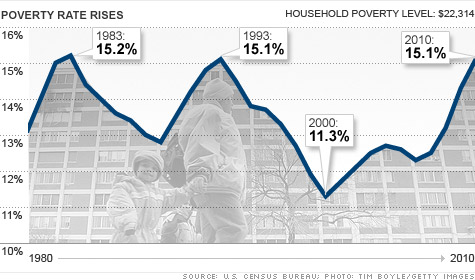
chart-census-poverty.top.jpgThe US fares well overall in the HDI, behind only Norway and Australia. When adjusted for inequality, however, the US drops to an embarrassing 16th. Adjusting for inequality is sensible as the whole point of measuring human development is to determine how a society is faring, not just to measure the lives of a few very high income citizens. Some in the US live very well; on the other hand, about 80 percent of Americans will have a brush with poverty at some point in their lives. By any reasonable reckoning that suggests that many if not most Americans are exposed to a high degree of economic insecurity. And, as depicted in the chart to the right, recently poverty in the US equaled a 27 year high. Worse, childhood poverty in the US is higher than in all other developed nations except Romania--at about 23 percent. This is both morally reprehensible and economically backwards. Such a high level of poverty (particularly among children) is inconsistent with a healthy society. No nation can reach its economic potential if a high percentage of its people are in poverty because impoverished people struggle just to survive rather than thriving economically or investing in enhanced productive capability.

The fundamental difference between the US and the rest of the developed world in terms of the HDI and poverty is tax policy. Every nation that scores higher than the US in both the HDI as well as the inequality adjusted HDI taxes their economy more than the US in terms of total tax revenues as a ratio of GDP. In fact, among developed nations only Mexico and Chile tax less. Some nations such as Denmark and Sweden tax at nearly twice the rate as the US. The average developed nation taxes more than ten percent more of its GDP than the US. According to Citizens for Tax Justice, relying upon OECD data, the US historically taxed its economy at more internationally comparable rates. In 2000, the US was just four percentage points below average--and actually rang up a significant federal surplus. In 1965, the US taxed at the same rate as other OECD nations.

Sweden has a childhood poverty rate of about 7.5 percent, and Denmark's childhood poverty rate is even lower at about 7 percent. Both Sweden and Denmark enjoy a higher life expectancy than the US. Yet, despite higher levels of taxation and achieving superior social outcomes both nations also generate higher per capita GDP than the US according to the World Bank. In fact, of all the nations in the graphic to the right that tax more than the US no less than seven have higher GDP per capita than the US (sometimes substantially higher). Six of those seven nations also enjoy higher inequality adjusted HDI scores than the US: Sweden, Switzerland, Norway, Australia, Canada and Denmark. All six have higher life expectancy--as much as four years higher. So, national economic success is not compromised by taxes that are used to empower people by lifting them out of poverty or enhancing their health outcomes. In fact, people seem to live longer and better in higher taxation nations.

The problem with the US is that we have chronically deprived the government of the resources needed to empower our people. The problem is not limited to just taxes but also where we spend our government resources. For example, none of the nations discussed above bears the burden of sending more than $700 billion on defense. Indeed, the US spends nearly as much on defense as the rest of the developed world combined. Further, total federal tax revenues as a percentage of GDP now stand at a 50 year low.

Thus, the US government simply lacks the tax revenues to invest in its people. Take the GI Bill as an example: The original GI Bill put in place after World War II generated economic benefits of up to $12.50 for every dollar the government spent. College degrees conferred in the US soared from 217,000 in 1940 to 499,000 in 1950. This was human development on a grand scale. Today, the GI Bill grants benefits that are a shadow of the original bill. As two noted scholars report: "Despite the mammoth scope and potential cost of the Post 9/11 G.I. Bill, the new bill is not nearly as lavish as the original GI Bill of 1944."
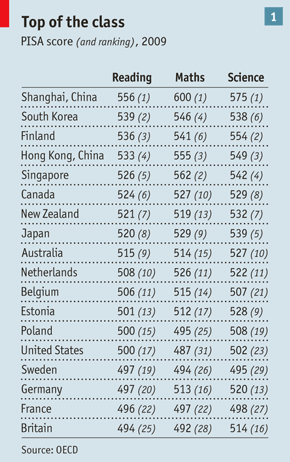
Across educational outcomes the US is fast sinking to the bottom of the developed world. In tertiary education graduation the US fell from fourth to 14th among developed nations in just 17 years and is now below the OECD average. In the latest international assessment of primary education outcomes the US scored dead last among 17 nations. In the most recent PISA scores the US 15 year olds ranked 31st out of 32 nations in math scores  and 23rd out of 32 in science as shown in the chart at right. This should come as no surprise as impoverished children simply cannot reach full educational capacity.

Essentially, we have reached precisely the point of my earlier blog on human development across states: "conservative economic ideology of less government and more laissez faire policies delivers inferior outputs for people in terms of objective measures of well-being. Sound regulation, investment in human and other infrastructure, and economic empowerment work--and that requires a robust government." But, looking at the facts trans-nationally, one cannot help but to find my conclusion from Law Capitalism correct: "The U.S. under-invests in education and fails to use its resources effectively. Given the centrality of ideas to economic growth, the U.S. abdicated economic leadership over the past twelve to fifteen years."

Of course, it really does not matter to governing elites whether the US can compete globally or whether the US slides slowly into third world status. They rigged college admissions so their kids win no matter what. And, their kids will get the finest education money can buy at super-elite private schools: "Exeter devotes an average of $63,500 annually to house and educate each of its 1,000 students." If they can convince 51 percent of voters that laissez faire produces the best outcomes against all evidence then (literally) more power to them.

Wednesday, August 7, 2013

Deadly Conservative Ideology Strangling Red States

I stumbled across an interesting fact recently. The Reddest states (those states most reliable for the GOP) also have the lowest life expectancy. So, for example, the thirteen worst states for life expectancy (in order: Mississippi, West Virginia, Kentucky, Alabama, Tennessee, Oklahoma, Louisiana, Arkansas, Georgia, North Carolina, Texas, South Carolina and Missouri) all went for Mitt Romney in the last presidential election and have been virtually all Red for 17 years and counting. (See 270toWin.com). Meanwhile, the Bluest states have the longest life expectancy. Every one of the top eight states in life expectancy (Hawaii, Connecticut, Minnesota, Florida, Colorado, Vermont, New Hampshire and Washington) went for President Obama. The differences in life expectancy among the states is not trifling. Hawaii's life expectancy exceeds Mississippi's by 6.3 years. The only conclusion is that not only is conservative ideology a failure, but conservatives are killing themselves in pursuit of some twisted laissez faire fantasy.
Of course, quality of life matters, too. The Measure of America project is a non-partisan, non-profit initiative that addresses human development issues in the US. They created the American Human Development Index. The index (HDI) is expressed as a number from 0 to 10, and measures the three basic dimensions of well-being--longevity, access to knowledge, and standard of living. The HDI is calculated from official U.S. government mortality data to measure longevity, a combination of educational attainment and school enrollment to measure knowledge, and median personal earnings to measure standard of living. The top 18 states in HDI all voted for Obama, as did 21 of the top 25. All of the bottom 10 (and 15 of the bottom 16) voted for Romney.  In education, the six states with the lowest level of high school graduation all went for Romney; and, every state with more than 14 percent of its citizens holding graduate degrees went for Obama. That can only be termed a real landslide.

Additionally, as shown in this post from The Economist, the Blue States massively subsidize the Red States. Over a twenty year period, 1990 to 2009, the states with the heaviest surplus (meaning they paid into the federal coffers more than they took in federal benefits) were all stalwart Blue States. In order they are: Delaware, Minnesota, New Jersey, Illinois, Connecticut and New York. Five of the bottom six deficit states are Red State bastions. The map at left depicts the reality of massive fiscal transfers from the Bluest States to the Reddest States. Without this support from the Blue States, life in the Red States would likely be quite wretched. Certainly, without billions flowing annually from the most productive (Blue) states to the fiscal drag states (mostly but not all Red), life expectancy, educational attainment and income would drop.

More broadly, conservative economic ideology of less government and more laissez faire policies delivers inferior outputs for people in terms of objective measures of well-being. Sound regulation, investment in human and other infrastructure, and economic empowerment work--and that requires a robust government.

Of course, this in no way vindicates the current wrongheaded Democratic indulgence of the megabanks under federal law which I have written about again and again.

One view of the GOP and Democratic approaches is this: both parties coddle the most powerful, particularly at the apex of our system, but the Democrats at least pursue some degree of broader empowerment consistent with higher HDI scores in states they dominate the most. Meanwhile, the GOP, very much like the Democrats, neglect props to economic growth to the maximum extent they can, given the political context in the states they dominate the most. A perfect two party system in an era of soaring inequality as depicted below--it serves the interests of a small cadre of uber elites first and foremost. After all, only the very wealthy can bank roll campaigns, offer politicians windfall compensation for mega-millions, or dole out hot stock tips.

The only way out of our continued swoon is for a new cultural norm to emerge that would cause voters to aggressively vote against those that serve the most powerful and to aggressively support leaders that are proven to be the strongest champions of the dis-empowered. Then American prosperity can return to levels of decades past and the era of Lawless Capitalism can end.

Monday, August 5, 2013

Credit Rating Agencies Still for Sale?

In yet another scathing rebuke, Matt Taibbi of Rolling Stone underscores the role of the rating agencies in the financial market crisis in his latest piece called "The Last Mystery of the Financial Crisis."  As reported repeatedly on the Corporate Justice Blog, and Taibbi's investigative report buttresses the posts, significant blame for the mortgage crisis lays at the feet of the corrupted credit rating agencies, Moody's, Standard & Poor's and Fitch.  Based on recent court documents made public following the rating agencies $255 million settlement for their roles in knowingly mis-rating mortgage backed security investment vehicles in the run-up to the mortgage meltdown, a pitiful story is revealed of full blown rating agency head-bowed acquiescence to the demands of mega-banks (like Morgan Stanely) simply for the money - pay us enough and we will give you the rating that you want, science and integrity be damned.

From Rolling Stone and Taibbi:  "Thanks to a mountain of evidence gathered for a pair of major lawsuits by the San Diego-based law firm Robbins Geller Rudman & Dowd, documents that for the most part have never been seen by the general public, we now know that the nation's two top ratings companies, Moody's and S&P, have for many years been shameless tools for the banks, willing to give just about anything a high rating in exchange for cash.  In incriminating e-mail after incriminating e-mail, executives and analysts from these companies are caught admitting their entire business model is crooked. . . .

[The rating agency's] primary function is to help define what's safe to buy, and what isn't. A triple-A rating is to the financial world what the USDA seal of approval is to a meat-eater . . .  It's supposed to be sacrosanct, inviolable: According to Moody's own reports, AAA investments "should survive the equivalent of the U.S. Great Depression.  It's not a stretch to say the whole financial industry revolves around the compass point of the absolutely safe AAA rating. But the financial crisis happened because AAA ratings stopped being something that had to be earned and turned into something that could be paid for."

The story is worth the read, as the incest amongst Wall Street Banks and the Credit Rating Agencies in the period prior to the market collapse is simply unbelievable.  More unbelievable still, the credit rating agencies remain in business and very little has changed.

Again, from Taibbi:  "2008 was to the American economy what 9/11 was to national security. Yet while 9/11 prompted the U.S. government to tear up half the Constitution in the name of public safety, after 2008, authorities went in the other direction [with the credit rating agency process]. If you can imagine a post-9/11 scenario where there were no metal detectors at airports and people could walk on carrying chain saws and meat cleavers, you get a rough idea of what was done to reform the ratings process.  Specifically, very little was done to change the way AAA ratings are created – the "issuer pays" model still exists, and the "Big Three" retain roughly the same market share. An effort by Minnesota Sen. Al Franken to change the compensation model through a new approach under which agencies would be assigned to rate new issues through a government agency passed overwhelmingly in the Senate, but in the House it was relegated to a study by the SEC – which released its findings last year, calling for . . . more study. "The conflict of interest still exists in the exact same way," says a frustrated Franken."

Corruption rewarded?  Wouldn't the most efficient response be to blow up Moody's, S&P's and Fitch and begin from scratch, where integrity is the most important outcome?

Friday, August 2, 2013

Dodd-Frank at Three: More Lawless Capitalism

President Barack Obama signed the Dodd-Frank Act on July 21, 2010. How has the Act fared after three Years?

Well, according to CNBC, only 39% of all the regulatory rule-making required under the Act has been completed (see video at right, at 0:44). The megabanks have lobbied the top regulators to the hilt, meeting with them over 1,000 times (1:58). Indeed, the Sunlight Foundation finds that: "As the Dodd-Frank law passes its third anniversary, lagging on deadlines, and increasingly defanged, the meetings log data offer a compelling reason why: the banks have overwhelmed the regulators." CFTC Commissioner Bart Chilton states: "Much of Dodd-Frank is dying on the vine. Lobbying, litigation and lawmakers who have tried to defund and defang Dodd-Frank have all brought rule-writing to a crawl." Chilton continues: "Regulators themselves have become overly concerned about finalizing rules. Over-analysis, paralysis, fears of litigation risks, and the lack of people-power have all contributed to the slowdown." According to former Rep. Barney Frank, the GOP controlled House has stripped out the resources needed at key regulatory agencies to effectuate the purpose of the Act (4:27). I predicted that a lobbying blitz would defang Dodd-Frank in August 2010. Thus, none of this effort or its success should surprise anyone who has followed the use of power to corrupt law and regulation in the past few decades, as demonstrated in Lawless Capitalism.

TBTF LIVES

More surprising, Rep. Frank issued a challenge regarding Too-Big-to-Fail (TBTF) (8:13). He claims Dodd-Frank makes every bailout of 2008 "impossible." That is simply nonsense, as I posted on the day after the Dodd-Frank Act was signed. Specifically, the Dodd-Frank Act amends section 13(3) of the Federal Reserve Act in a way that paves the way for the Fed to bailout large banks so long as it does so pursuant to a program or facility that features "broad-based eligibility." Indeed, the Act directs the Fed and the Treasury to create emergency lending programs and facilities "as soon as practicable." The only limitations the Act imposes on this emergency lending power is that borrowers cannot already be in bankruptcy or receivership and the loan cannot be made with the "purpose of" assisting a "single and specific company."

New section 13(3) of the Federal Reserve Act empowers the Fed to provide for loan programs with "broad-based eligibility" for "the purpose of providing liquidity to the financial system." It is hard to see how the new section would stop bailouts like the AIG Bailout or the Bear Stearns Bailout--both of which explicitly occurred under section 13(3).

That is why both Treasury Secretary Lew and Fed Chair Bernanke now admit that TBTF has not been solved yet.

THE DERIVATIVES CASINO IS STILL OPEN

The megabank lobby also has scored impressive wins in derailing derivatives regulation. In May, the SEC under the leadership of Mary Jo White voted to exempt foreign subsidiaries and foreign megabanks from complying with Dodd-Frank. Meanwhile, the CFTC recently voted to delay the overseas impact of its derivatives regulations and a bill in Congress would mandate that the CFTC follow the lead of the SEC, and defer to nations with weaker oversight. Most of the great derivatives mischief in recent years occurred at foreign subsidiaries--the AIG fiasco, the Chase London Whale losses, Citigroup's off-balance sheet SIVs and Long Term Capital Management's implosion.

On May 16, the CFTC curtailed the obligation for derivatives clearing houses to facilitate competitive markets by cutting the number of required bids for a given trade from 5 to 2. The swing vote on this action was supplied by Commissioner Mark Wetjen who some think may soon head the CFTC.

This comes on the heels of another notable win for the megabanks. Specifically, the SEC and CFTC voted last year to reduce the threshold for derivative dealer regulation from $100 million in derivatives contracts per year to $8 billion. Further there are significant exemptions from that $8 billion limit. "Under the rule, companies can exclude the swaps they use to hedge their business against risk like, say, interest rate fluctuations. And the rule would apply only to a company’s swaps transactions, so firms would not need to count their other varieties of derivatives, like forwards and options." This means fewer (as few as 15%) trading firms will be designated as swap dealers and thus subject to the most stringent capital and collateral requirements.

VOLCKER RULE DELAYED

 The Volcker Rule was intended to put the "kibosh on most proprietary trading, which is when an institution that has access to Federal Reserve funds and insured deposits (i.e. all big banks) invests with its own funds for profit. It also limits the ability of banks to use their own funds in risky activities like derivatives trading." Originally scheduled to take effect in July of 2012, the rule has been delayed until July of 2014. In the meantime, expect massive lobbying because banks "hate" this rule. As former Chief Economist at the IMF, Simon Johnson, puts it the rule will "no doubt continue to draw a lot of pushback and gaming by the industry.”

Dodd-Frank is not without its positive effects. I have blogged previously about its potential to mitigate CEO primacy and its impact on curtailing predatory lending.   

But, fundamentally, after three years, it does not prevent banks from gambling on speculative trades with the backing of the US government. That almost certainly means too much risk in the system and more crises down the road, as I predicted in Dodd-Frank as Maginot Line.


Tuesday, July 30, 2013

Great Recession Cost United States Up to $14 Trillion

To those apologists that claim that the megabanks have repaid their TARP loans, thus no harm no foul for the egregious bubble behavior that precipitated the mortgage crisis, the Dallas Fed has just released a report that estimates that the crisis will end up costing the U.S. between $6 trillion and $14 trillion in lost economic output.  According to economists Tyler Atkinson, David Luttrell, and Harvey Rosenblum, the study estimates the difference between actual and projected economic growth and the growth that likely would have occurred had the crisis never taken place.  These economists called their estimate "conservative," noting that quantifying the trauma of job loss, rising unemployment, and the "burden of unemployment" likely makes their estimate a "drastic understatement" of the cost of the crisis.

In addition, Barron's reports that the "second great contraction" in the U.S. strained the federal government's resources and capabilities by adding to the level of government debt. . . .  "Some critics of big banks, such as the Massachusetts Institute of Technology’s Simon Johnson, have argued that the lost output and tax revenues caused by the financial crisis strengthen the case for stricter regulation of banking.  Richard Fisher, the president of the Dallas Fed, is a prominent critic of too-big-to-fail banks and has called for Wall Street’s biggest banks to be broken up."


From the report:  "The “Second Great Contraction ”in the U.S. was the result of a confl‡uence of factors: bad loans made by banks, ratings agencies falling down on the job, lax regulatory policies, misguided government incentives that encouraged banks to be reckless in their lending, and even monetary policy that kept interest rates too low for too long.

The Second Great Contraction, the worst economic downturn since the 1930s, was unusual because it stemmed from an easing of credit standards and an abundance of …financing that had fueled the prior expansion. This fuel also helped create imbalances— an overextension of mortgage …financing and capital market fi…nancial intermediation. A housing collapse and credit shocks, culminating in a fi…nancial crisis, hit the economy as these fi…nancial practices generated new losses. Home construction plunged, the stock market crashed, commodity prices tumbled, job losses mounted, credit standards tightened, and short-term funding markets seized up."

The culmination of this morass is lost economic output between $6 and $14 trillion dollars.  Indeed, repaying TARP loans appears to only be the tip of the iceberg that the Wall Street banks owe the citizens of this nation as far as restitution and penitence is concerned.

Friday, July 26, 2013

Megabankers Face a 10 Year Statute of Limitations

This blog has consistently urged more accountability for financial elites at the megabanks. While the Obama administration clearly gets a failing grade for enforcing criminal statutes against those at the megabanks, another Attorney General or administration can still bring criminal charges so long as the statute of limitations has not expired. This would be a first step in restoring the rule of law to the financial sector and stemming the most egregious element of lawless capitalism. So what is the statute of limitations applicable to bank frauds and other crimes affecting a financial institution?

Under 18 U.S.C.§ 3293 the limitations period for criminal charges for bank fraud as well as wire fraud and mail fraud that "affects a financial institution" is 10 years. This is twice as long as the five year statute that generally provides the limitations period for federal offenses and four years longer than the limitations period applicable to securities violations and commodities fraud. The definition of a "financial institution" includes any insured depository institution and any holding company of any insured depository institution. Further, federal frauds may involve schemes that continue beyond the fraudulent mailing or transmission that effectively will extend that period to 10 years after the scheme has ended. Moreover, under United States v. Pelullo, 964 F.2d 193 (3d Cir. 1992), frauds affecting a subsidiary of a financial institution "affect a financial institution." By the same logic, any loss to any subsidiary of a holding company also will "affect a financial institution." Finally, any fraud committed within a financial institution clearly "affects a financial institution" and is subject to the 10 year statute of limitations because it exposes the financial institution to an increased risk of loss.

Interestingly, Congress added the term "mortgage lending business" to the definition of financial institution under 18 U.S.C.§ 20 as part of the Fraud Enforcement Recovery Act of 2009. "Congress, of course, has the power to extend the period of limitations without running afoul of the ex post facto clause, provided the [original] period has not already run.” United States v. Madia, 955 F.2d 538 (8th Cir.1992). In general, statutes of limitation are deemed procedural and are applicable to claims brought after the enactment of the statute. Thus, any criminal charges relating to a "mortgage lending business" brought after May 20, 2009 are subject to the new 10 year statute of limitations so long as not already time-barred as of that date.

What does all this mean? It means that virtually all of the putative criminal conduct at the megabanks arising from the crisis of 2007-2009 is not time-barred until 2017 at the earliest.

 For example, consider the misconduct of Angelo Mozilo, the former CEO of Countrywide. The SEC charged Mozilo with securities fraud in a civil action. On the eve of trial the case settled for nearly $70 million. The SEC charged Mozilo with securities fraud in connection with his sale of almost $140 million of Countrywide securities between November of 2006 and August of 2007. Shortly thereafter Countrywide drowned in an ocean of subprime loan defaults and its stock price plunged. The SEC alleged that Mozilo knew of the problems with the quality of Countrywide subprime loans when he sold his shares even though Countrywide shareholders had no clue. Mozilo agreed to the largest fine ever for a pubic company's senior executive to settle with the SEC. As the Supreme Court recently ruled, the SEC would be subject to a five year statute of limitations for this kind of claim. If the DOJ picked up on the investigation of the SEC and pursued a criminal securities fraud actions, then the general criminal statute of limitations (18 U.S.C.§ 3282)
of five years would apply.

But there would be at least four possible bases for applying the 10 year statute of limitations to Mozilo for the very same factual allegations that the SEC made against Mozilo: 1) his misconduct affected a mortgage lending business; 2) his misconduct caused losses to any financial institution that held shares in Countrywide; 3) his misconduct caused a risk of loss to Countrywide Bank FSB or its holding company; 4) his misconduct caused losses to financial institutions that relied on the same misrepresentations Countrywide made to shareholders regarding the safety and soundness of its underwriting of home loans.

Of course, there has been no finding by any jury yet that Mozilo violated any criminal law. The only point here is that based upon what we now know about Mozilo and Countrywide, it is highly unlikely that any criminal indictment against Mozilo would be time-barred before 2017, more than four years from now.

The same holds true for Goldman Sachs, Citigroup, JP Morgan Chase, Lehman Brothers and Bank of America. Each of these entities is either a "financial institution" or is affiliated with a "financial institution" or dealt with a financial institution fraudulently according to SEC investigations underlying civil settlements (or, in the case of Lehman Brothers a bankruptcy investigation).

AIG also was affiliated with financial institution. As an insurance company there is another 10 year federal statute of limitations applicable to criminality by AIG's senior officers and directors. So, consider Joe Cassano's now infamous statement in August 2007: "It is hard for us, without being flippant, to even see a scenario within any kind of realm of reason that would see us losing one dollar in any of those transactions." One year later AIG posted the largest loss ever in corporate history from "those" credit default swap transactions. If this statement defrauded even one financial institution then the statute of limitations for any such fraud will not expire before August 2017.

The bottom line is that the overwhelming majority of potential criminal charges against the megabankers (as individuals) will not expire until 2017 at earliest. This means that WE THE PEOPLE have two elections ahead to elect responsible leaders that understand the importance of the rule of law and imposing accountability on even the most powerful economic actors. Indeed, perhaps Congress could even extend the statute of limitations to 15 years.
.

Monday, July 22, 2013

The Great Derivatives Scam

FRED GraphIt is hard to overstate the impact of megabank derivatives trading on our economy. Although three years after Dodd-Frank they remain a virtually dark market, experts estimate that the derivatives market may now exceed $1.2 quadrillion. A Quadrillion has 15 zeros and looks like this: 1,000,000,000,000,000.

Another way of thinking about that huge number is that it amounts to 20 times the entire global economy. While that huge number is only the notional amount it still represents a huge commitment of the world's capital resources--perhaps as much as $10 to $20 trillion dollars. All this capital is committed to an enormous zero sum game that carries an enormous risk of blowing up the financial system as occurred in 2008. As Michael Sivy points out, even a small move either way in the value of the huge notional amount of derivatives would wipe-out even well-capitalized banks. The size of the market necessarily implies huge problems and risks.

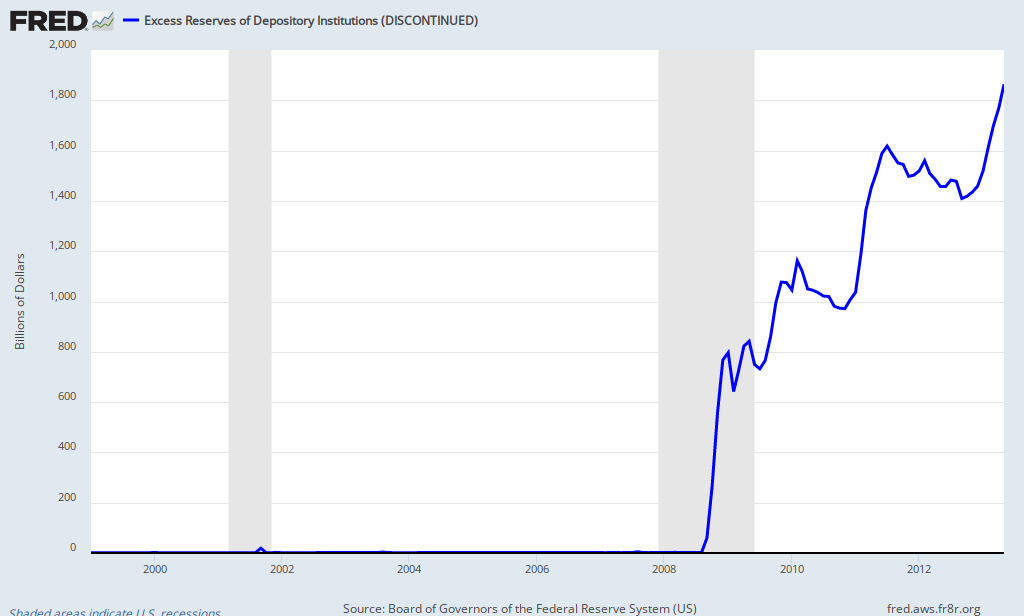
First, I contend that much of the so-called "money printing" of the Federal Reserve is dedicated to to derivatives trading with nearly zero resulting credit expansion at the megabanks. Second, much of the trading is the direct result of accounting fraud--specifically the accounting rules allow both counterparties to the same trade to recognize gains and this allows the megabanks to pump up their earnings accordingly. Third, a huge percentage of the trading occurs only because the megabanks can sell their too big to fail status to counterparties which in turn encourages more risk throughout the economy. Fourth, derivatives trading is heavily subsidized by depositors who now stand behind derivatives counterparties if a megabank fails. Thus, the next financial crisis will demonstrate that derivatives still pose a lethal risk to the global economy.


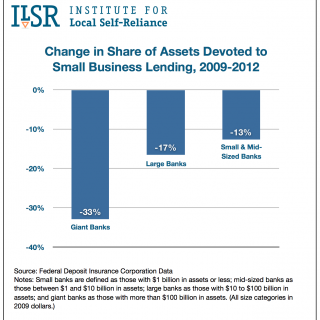
1) Fed and monetary policy. As demonstrated by the above chart, the monetary transmission is  and has been broken. Banks are not lending. Everyone agrees that if bank lending proceeded apace the economy would be expanding. Instead the banking system hoards excess reserves that could be lent out. In the wake of the crisis, the megabanks cut small business loans lending at more than twice the rate of community banks, as reflected in the chart in the chart at right. Thus, despite massive excess reserve to lend, bank lending still has not recovered to the pre-crisis. On the other hand, excess reserves held at the Fed are an ideal form of collateral for derivatives transactions, as my friend Christian Johnson explains, here at p. 9. And, since the Fed pays interest on excess reserves of .25 percent (well over the market rate for short term Treasuries with high liquidity of essentially zero percent), the Fed is basically subsidizing the megabanks' collateral on derivatives to the tune of billions of dollars per annum. The precise extent of this subsidy is unknowable; but the total subsidy to all commercial banks totals $5 billion per annum (.0025 times $2 trillion in reserves). While the exact numbers are difficult to pin down it is obvious that derivative trading is squeezing out lending and the Fed facilitates this activity through its payment of above market interest rates for banks holding excess reserves. In fact, trading profits are the key driver of megabank earnings as evident here, here, here and here. Simply put huge amounts of derivatives trading are squeezing out lending at the cost of economic growth.

2) Derivatives and Accounting Manipulation. The megabanks hold a total of about $210 trillion dollars in derivatives, nearly all of which are not traded on transparent exchanges but instead are traded over the counter (OTC). Zero Hedge recently posted an illuminating blog entry on the business of derivatives trading and profit manipulation at the banks. According to Zero Hedge Bank of America's entire profit would have been wiped out under mark-to-market accounting. All of the bank's profit resulted from the mark-to-model accounting method permitted since 2009 when the FASB promulgated Staff Position 157-4. Trading of complex derivatives has always involved a subjective determination of "fair value." So subjective that both parties to a derivatives transaction can, in fact, claim profits on the same derivative transaction. In fact, after Lehman's bankruptcy collateral apparently was wildly up for grabs due to the vagaries of valuing derivatives positions. All of this means that while derivatives are technically a zero-sum game (negative sum when substantial transactions costs are included) the megabanks still profit mightily in this market because of imperfect accounting. Where else can two parties to a bi-lateral contract both claim profits?

3) Selling TBTF Status and Government Guarantees. The derivatives markets allows the megabanks to sell the full faith and credit of the US government. Indeed, one may wonder how much of the market would exist without the ability to sell government guarantees. After all, the main reason in favor of derivatives transactions is that allows the free flow of risk to those best able to bear it and those who desire it. There is little doubt that TBTF lives as argued on this blog on the date Dodd-Frank was signed-- the only question is the size of the subsidy (a question the FDIC recently tackled in this literature review). So the megabanks offer the ideal mechanism to shift risks: a default proof counterparty. This is why the top five megabanks control 95% of the derivatives market. Every derivatives counterparty wants a default proof counterparty. Further, the megabanks will under-price this government guarantee since they bear virtually no prospective cost of the guarantee at all. The corollary to this is that the entire economy takes on too much risk because the megabanks are in business to sell government guarantees to all buyers, and the banks will assume concentrated risk such as the JP Morgan London Whale trade that cost the megabank billions. This high risk trading can be more nefarious than initially appears. Perhaps the best proof of my point is the behavior of the megabanks themselves: when they suffered ratings downgrades they moved much of their derivatives business to their bank subsidiaries so that the trading would be backed by insured deposits.

4) The Death of Depositor Preference. After the Great Depression even governing elites accepted that bank runs constituted a lethal risk to capitalism. Sustainable credit is a key prop to growth. Yet, credit cannot expand to maximum sustainable levels without fractional reserve banking. If a community panics and runs on a bank then the bank must face failure or need to raise cash by pulling lines of credit and calling loans. The answer to this risk is deposit insurance. The FDIC effectively ended bank runs. Part of the effectiveness of deposit insurance is depositor preference regimes. Depositor preference means that the first claim (after administrative costs) on bank assets is depositors--even uninsured depositors. This bedrock principle of safe and sound deposit insurance  diminishes incentives for even uninsured depositors to panic and withdraw their funds from banks. The megabanks derivatives activities have ended depositor preference by distorting law and regulation and giving first claim on megabank assets to derivatives counterparties. Specifically, as Mark Roe writes here (and the FDIC apparently concurs here):

"derivative counterparties unlike most other. . .creditors, can seize and immediately liquidate collateral, readily net out gains and losses in their dealings with the bankrupt, terminate their contracts with the bankrupt, and keep both preferential eve-of-bankruptcy payments and fraudulent conveyances they obtained from the debtor, all in ways that favor them over the bankrupt’s other creditors. Their right to jump to the head of the bankruptcy repayment line, in ways that even ordinary secured creditors cannot, weakens their incentives for market discipline in managing their dealings with the debtor because the rules reduce their concern for the risk of counterparty failure and bankruptcy."

Basically, this means that derivatives creditors get an FDIC super-priority that no other bank creditor gets--not even a depositor. This super priority risks bank runs by large uninsured depositors who will justifiably flee the megabanks at the first sign of trouble. What will remain of a bank's assets once the derivatives creditors have grabbed all the collateral for their derivative claims?

All of the four above points show that derivatives exist largely as a function of government indulgences and subsidies that have nearly zero legitimate policy bases. It is yet another testament of the triumph of power over policy.

This is utter foolishness as it ignores basic financial history, further subsidizes zero sum transactions that threaten financial stability, and places the economic interests of a handful of financial elites above 300 million Americans and the entire global economy.

In fact, I can think of nothing positive to say about the legal and regulatory frameworks applicable today to derivatives and TBTF banks, as I previously argued, here, here, here, here, and here.

Thursday, July 18, 2013

More Cowbell . . . .

Jeffrey Skilling mug shot
Public Domain
Interesting and relevant corporate news over the past several days.  In catching up on recent stories pertinent to issues of justice, the following seem particularly relevant in connection with previous posts on the Corporate Justice Blog:

Enron's Skilling to Leave Prison in 2017 as Sentence Cut:  "Former Enron Corp. Chief Executive Officer Jeffrey Skilling, who spearheaded the fraud that destroyed the world’s largest energy trader, will leave prison in 2017 after his sentence was reduced to 14 years from 24.  U.S. District Judge Sim Lake III in Houston yesterday approved the terms of the deal made between prosecutors and Skilling, who appeared at the hearing dressed in prison-issued green clothes and wearing handcuffs that were removed in court. In exchange for a shorter sentence, Skilling, 59, agreed to forfeit $45 million, drop his bid for a new trial and end litigation over his 2006 conviction and sentence. The former CEO’s prison term was already set to be reduced by nine years, thanks to a 2011 appellate-court ruling that sentencing guidelines were incorrectly applied in his case."

 Wall Street's "Fabulous Fab" Heads to Trial:  "The trial of the infamous ex-Goldman Sachs trader Fabrice 'Fabulous Fab' Tourre, which start[ed] Monday [July 15, 2013], could put a face on the type of Wall Street recklessness that imploded the housing market and almost sank the economy five years ago. . . .  If Tourre is found liable, he could face a hefty fine from the SEC and be barred from working in the financial industry. 'The SEC can take a real bite out of you . . . The sky's the limit in terms of the monetary penalties.'  The SEC has filed civil charges against Tourre and is taking him to trial largely based on e-mail evidence. The SEC alleges that, based on the messages, Tourre knew he was selling compromised investments - packages of real estate debt that had been expected to fail and were being shorted by hedge fund firm Paulson & Co."

States Promise Quick Action on Election Laws After Ruling on Voting Rights Act:  "Across the South, Republicans are working to take advantage of a new political landscape after a divided U.S. Supreme Court freed all or part of 15 states, many of them in the old Confederacy, from having to ask Washington's permission before changing election procedures in jurisdictions with histories of discrimination.  After the high court announced its momentous ruling . . . officials in Texas and Mississippi pledged to immediately implement laws requiring voters to show photo identification before getting a ballot. North Carolina Republicans promised they would quickly try to adopt a similar law. Florida now appears free to set its early voting hours however Gov. Rick Scott and the GOP Legislature please. And Georgia's most populous county likely will use county commission districts that Republican state legislators drew over the objections of local Democrats."

Marissa Mayer
courtesy of Wikimedia Commons/Giorgio Montersino

How One Year of Marissa Mayer has Changed Yahoo:  "Yahoo CEO Marissa Mayer likes to shop.  During Mayer's one-year tenure -- her start date was a year ago Wednesday [July 17, 2013] -- Yahoo has bought an incredible 16 startups. And she didn't even start the buying spree until she'd been CEO for three months. Since then Yahoo's acquisitions have been made at a breakneck pace, with the company sometimes announcing two purchases in a single day, or six over the course of a month.  'It is just astounding how truly active Yahoo has been on the M&A front,' said S&P Capital equity analyst Scott Kessler. 'They're mostly buying very small companies, but still -- I don't know that any other company has matched this pace of buying.'"


Monday, July 15, 2013

"Professor Calls War on Drugs an 'Abomination'"

The War on Drugs has been waged in a wildly discriminatory manner.  The decision to wage the war on drugs in urban and poor communities from its inception was a conscious decision made by lawmakers and politicians from the very early days of the so called "war."  Incarceration rates of African American and Latino citizens are massively out of proportion to their population rates, despite overwhelming evidence that Americans use drugs in very similar percentages across all races.  Two explanations for this disproportion in connection with drug arrests are first, that it is much easier to incarcerate citizens from poor and powerless communities, making it true that urban and poor communities are hyper-policed, while frat houses, suburban communities, and wealthy neighborhoods, where drug use is just as prevalent, are rarely policed; and second, that politicians and lawmakers deliberately waged the War on Drugs in urban and poor communities to re-subordinate minority citizens, in light of their gains from the Civil Rights movement, particularly passage of the Civil Rights Act and the Voting Rights Act (recall that President Nixon declared the War on Drugs in the early 1970s, and President Reagan federalized the war in the early 1980s, just a few years after real political and social gains were made by minority citizens).


cummings speaks to the Unitarian Universalist congregation
One of the primary reasons it has been so difficult to end the failed War on Drugs, is that corporate interests and profit increase are now deeply entangled and entrenched in the United States prison industry.  The advent of the private prison corporation in the late 1970s with the introduction of the Corrections Corporation of America in Tennessee, now ensures that dozens of millions of dollars are spent annually by private prison executives to lobby aggressively for increases in private prison facilities, increases in crimes that lead to jail time, increases in length of sentences, and increasing incarceration rates of American citizens and illegal residents.

Corporate interests are now energized by the profit potential of increasing incarceration in the United States.  Perverse incentives are innumerable now for the private prison executive.  Immoral motives, attendant stereotypes and damaging public perceptions have grown out resulting in outcomes such as the "Kids for Cash" scandal in Pennsylvania (where sitting state judges received bribes and kickbacks for every juvenile that they sentenced to jail time in a private juvenile detention center); the horrible Trayvon Martin murder and acquittal (where an innocent, random African American boy was profiled as a "punk," and "suspicous" likely drug dealer by a neighborhood watch volunteer who followed, shot and killed the youth); the SB-1070 "show your papers" law in Arizona (that was drafted by the private prison lobby and handed over to willing legislatures who introduced the law verbatim).  Terrible outcomes motivated by immoral and perverse incentives are the cognizable result of the private prison industry.

Saturday, July 13, 2013

Deflation Everywhere?

FRED Graph
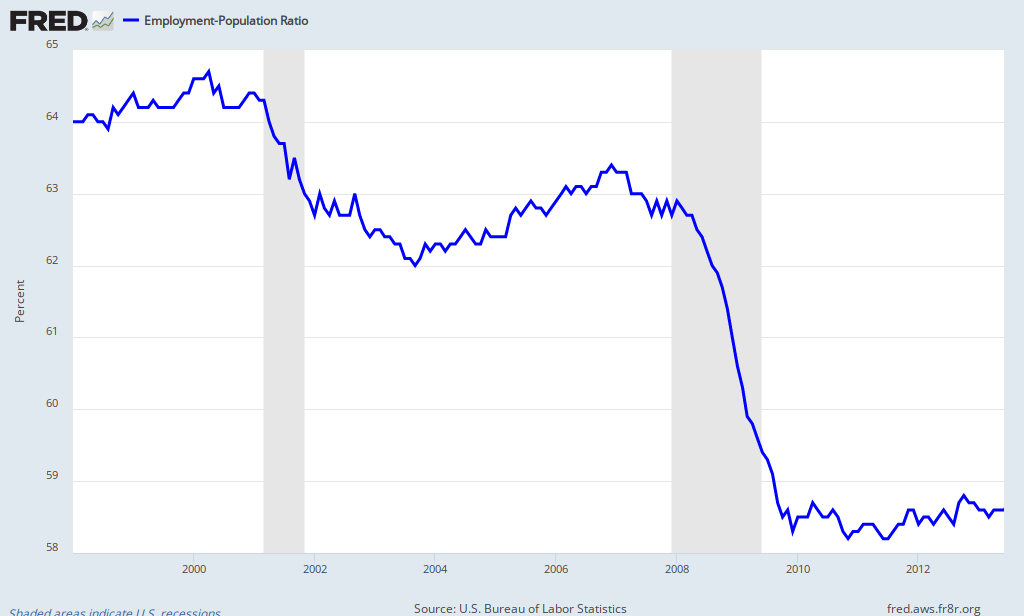
We all remember the unpleasant days of late 2008. As evident from the above, financial instability led to a solid two years of job losses. In terms of the broadest measure of employment, the ratio of the population that is employed, there has been little improvement since 2009 . Indeed, employment in America contracted for the last 13 years. We never recovered from the 2001 recession, much less the Great Recession of 2007-09. That takes a toll on an economy as fewer jobs means less demand and less opportunity for innovation (which is the only true source of sustainable growth). It is also fundamentally deflationary as workers cannot demand wage increases, breaking the possibility of an inflationary spiral.

In fact, while US productivity soared, "[w]ages have fallen to a record low as a share of America’s gross domestic product. Until 1975, wages nearly always accounted for more than 50 percent of the nation’s G.D.P., but last year wages fell to a record low of 43.5 percent. Since 2001, when the wage share was 49 percent, there has been a steep slide." This basic loss of buying power (relative to output) for workers combined with loss of bargaining power for wage increases creates a powerful deflationary bias in our economy. Just look:


As The Economist notes: "The core PCE number (personal consumption expenditure deflator) is only 1% - a modern low - and the Dallas Fed, which uses a trimmed mean number (eliminating the outliers), actually recorded a small fall in the latest numbers (see the definition here)."

In the face of all this evidence of deflationary forces, the US now assumes a contractionary fiscal policy due to the mindless sequestration and the Fed is talking about tapering-off its monetary stimulus. Both fiscal and monetary policy now look strongly contractionary in the US.

Economic stagnation looks worse in other parts of the world. In the Eurozone unemployment recently reached an all time high of 12.2 percent which flirts with outright depression. Some areas of the Eurozone are already in deep depression with only bleak prospects ahead. In Spain, unemployment hovers at 27 percent. I blogged recently about the biggest basket case in Europe (Italy) but in fact austerity has failed everywhere and southern European debt burdens have increased not decreased as the eurocrats promised. Politically, disruptions could erupt at any minute across the Eurozone, as Spain is reportedly in a pre-revolutionary state and even France is fraying. Just this week Portuguese debt yields spiked to highs not seen for months; this signals real problems ahead in the Eurozone.

Then there is China. The world's second largest economy is clearly slowing down. China recently experienced a dramatic credit crunch that suggests its banking sector is overextended. Some experts see major problems ahead. At the very least, China is losing steam and cannot support global growth anytime soon.

“Japan’s economy is starting to recover moderately.” But, the problem here is that Japan is already in a deflationary spiral and prices only stopped falling in May. This progress all comes at the expense of the rest of the world which suffers as Japan drives down the value of the Yen and exports deflation. It is not internally generated growth as the rest of the world recognizes. As the Yen declines (20 percent in just 8 months), Japan can effectively flood the world with cheap goods. As one expert states: "Forget cars, Nintendo machines or anime. Japan’s biggest export right now is deflation."

So, looking at all the world's biggest economies, it is hard to remember more deflationary pressures than right now. Certainly, not since the summer of 2008 did the global economy seem more vulnerable to a major shock.

Friday, July 12, 2013

Is Italy the Next Cyprus?


 http://image1.frequency.com/uri/w234_h132_ctrim_ll/_/item/1/0/4/9/MORE_BANK_RUNS_COMING_ACROSS_EUROPE_104945338_thumbnail.jpg
S&P downgraded Italy earlier this week.
European financial experts project that Italy will need a financial bailout within six months. Italy has about $2.5 trillion in outstanding debt--meaning that any problems with a possible default will send a tsunami through global financial markets. So how likely is an Italian credit crisis?

Consider the following facts: Italy's economy has contracted for 7 straight quarters; industrial production has fallen for 15 straight months; since 2008 factory output has plunged 25 percent; poverty has doubled; and its debt has soared to 130 percent of GDP. Austerity has increased Italy's debt load, crashed its economy and spawned immense suffering among the Italian people. Or, as economics Professor Krugman puts it: austerity has been a "disastrous failure." He is not the only Nobel laureate who thinks that. Indeed, the stability of the government itself has been compromised and the high unemployment rate for Italian youth (38.5 percent) promises more political unrest.

Italy is also way behind on its bills and does not have the funds to pay. This in turn is leading to mass bankruptcies of Italian businesses.

A default sure seems credible from my view. What does that look like?

The place to start for that question is Cyprus. This was the most recent and most radical bailout by the EU, the IMF and ECB. Basically, this trioka of eurocrats deemed that depositors must pay and pay big for the errant ways of Cypriot banks. Thus, uninsured depositors were forced to become shareholders of insolvent banks (up to 60 percent of the amount that exceeds $130,000) and had most of the rest of their deposits frozen. Even insured deposits are subject to capital controls that have been in place since late March and will not be lifted until at least September: this means that all depositors can only withdraw about $400 per day, cannot cash checks, and face monthly limits on transfers out of the country. Who needs that noise, and how does one know it will not worsen?

Cyprus is the new "model" for Eurozone bailouts. Deposit confiscation, limited only by what the eurocrats think the government can get away with.

Given these facts who in their right mind would leave any money in Italian banks? And, if Italy proved too big to bail out, why would anyone leave money in Spanish, Portugese, and Greek banks? Under these circumstances Eurozone bank runs on a massive scale seem almost inevitable and certainly rational.

Saturday, July 6, 2013

Reflections on the Fourth of July 2013

I watched many fireworks this past few days. I also ate well.

In between, I thought hard about this celebration of America. In particular I thought very hard about the meaning of Gettysburg, the enormous Civil War battle that occurred 150 years ago in Pennsylvania (1 July 1863 to 3 July 1863).

Here are my conclusions, for better or worse:

1) The United States is Revolution Proof

Basically, a strong majority will at least appear to prevail in the political arena and will thus find accommodation within our Constitutional system. A determined and organized minority may revolt--as the Confederacy did in 1861--but they will lose as they will be out-manned and out-gunned given the position of the President as Commander in Chief of the Armed Forces.

2) The South Never Stood a Chance

Gettysburg marks the high tide of the Confederacy. By all accounts, General Lee desperately needed a complete victory so he could march on Washington and seek a negotiated peace. Despite a long string of victories Lee understood that the South was out of troops and munitions and the North was nearly inexhaustible. This meant he needed to gamble and seize the offensive. Gettysburg was the logical conclusion of that gamble. The Union held dug-in positions on the high ground. Lee's attack resulted in the loss of over 1/3 of his Army which rendered victory in the ensuing war of attrition impossible. It is hard to imagine a stronger rebellion than the Confederacy--yet, it failed.

3) Revolution by Other Means is Similarly Impossible

In some nations, protests, coups and other mechanisms have resulted in regime change. But, not in the USA. In the US superior leaders are generally co-opted into the system. Because the US has long been the land of opportunity (albeit less so in recent years) the most talented in the system soon become invested in the system. People with IRA accounts and 30 year mortgages are not likely to revolt.


4) Those Seeking Change Must Work Within the US Constitution and Under Law

All of this precludes radical change in the US. Only change within the existing legal framework is possible and desirable. Overall, the historical outcomes of revolutions are mixed at best. It is hard to find a successful rebellion in a functioning republic or democracy.

The upshot of this is that any talk of violent armed revolt is nonsense. The US military is so advanced today that no amount of small arms can match it.

Those interested in change should look to history to learn how legal and regulatory reforms took root in the past. Similarly, one can analyze law and determine mechanisms available for durable reform. Reformers can also study political contexts that support reform efforts and try to propose reforms that fit with a given political context. This is the only path for reform in the US right now and those offering more radical paths are destined to fail and even further entrench the status quo.

Wednesday, July 3, 2013

Critical Race Theory: The Cutting Edge

Professors Richard Delgado and Jean Stefancik have just released the third edition of their seminal compilation Critical Race Theory: The Cutting Edge.  This book traces the evolution of Critical Race Theory and examines wide ranging topics, including economics, class, and wealth, critiquing and offering solutions through critical analysis. 

According to the Temple University Press: "Critical Race Theory has become a dynamic, eclectic, and growing movement in the study of law. With this third edition of Critical Race Theory, editors Richard Delgado and Jean Stefancic have created a reader for the twenty-first century—one that shakes up the legal academy, questions comfortable liberal premises, and leads the search for new ways of thinking about our nation's most intractable, and insoluble, problem—race.

The contributions, from a stellar roster of established and
emerging scholars, address new topics, such as intersectionality and black men on the "down low."  Essays also confront much-discussed issues of discrimination, workplace dynamics, affirmative action, and sexual politics. Also new to this volume are updated section introductions, author notes, questions for discussion, and reading lists for each unit. The volume also covers the spread of the movement to other disciplines such as education.

Offering a comprehensive and stimulating snapshot of current race jurisprudence and thought, this new edition of Critical Race Theory is essential for those interested in law, the multiculturalism movement, political science, education, and critical thought."