
Friday, August 31, 2012
MITT AND THE FOREIGN MEGABANKS
Perhaps the most offensive US government bailouts during 2008-2009 were the billions and billions spent keeping foreign megabanks afloat. The foreign megabanks benefited from two major government bank welfare programs that collectively dwarf any prior government spending program with the possible exception of World War II ($3.9 trillion in 2008 dollars): i) secret Fed loans ultimately uncovered by Bloomberg pursuant to a FOIA lawsuit; and, ii) the huge bailout of AIG which then turned around and paid 100 cents on the dollar to counterparties around the world on the infamous AIG credit default swaps.
Let's start with the secret emergency loans. In late 2008 and early 2009 the Fed (backed by the US taxpayer) lent a total of $16 trillion to save the global financial sector pursuant to seven publicly-announced programs. Until Bloomberg sued under FOIA, the identity of the borrowers under these programs was a closely guarded Fed secret. According to Bloomberg: "Almost half of the Fed’s top 30 borrowers, measured by peak balances, were European firms. They included Edinburgh-based Royal Bank of Scotland Plc, which took $84.5 billion, the most of any non-U.S. lender, and Zurich-based UBS, which got $77.2 billion. Germany’s Hypo Real Estate Holding AG borrowed $28.7 billion, an average of $21 million for each of its 1,366 employees." Without these loans, which peaked on December 5, 2008 at $1.2 trillion, the entire global economy likely would have collapsed. These amounts boggle the mind. With virtually zero democratic negotiation (no congressional vote, no election outcome, etc.) the Fed rescued the entire European financial sector, through trillions in outlays. Outrageous!
Next, the government paid billions more than necessary, much of it to foreign banks, when it jumped in and rescued AIG. None of the beneficiaries of that bailout bargained for a US government guarantee on the obligations that AIG owed--yet, the government made good on all of AIG's commitments. So, counterparties to AIG enjoyed a government guarantee for free. In all, foreign megabanks took in at least $50 billion in taxpayer supplied funds (according to this spreadsheet compiled by the Guardian) courtesy of the Federal Reserve.
So, next time, and there will be a next time, would a President Romney put a stop to US funded bailouts of foreign banks? I highly doubt it.
First, take another look at the OpenSecrets data on his top supporters: Credit Suisse gave $427,560; Barclay's gave $349,400; and UBS gave $259,200. These firms do not just give money away. And a President Romney simply would not have any incentive for turning on such major donors. To the contrary, he would need these kind of massive donations to fund his re-election campaign.
Second, Romney has sought out this source of donors; indeed, the global megabanks are his base. For example, he hosted a fundraiser just last month in London. Tickets to the fundraiser cost up to $75,000 a plate. According to the Washington Post, attendees included the CEO of Credit Suisse, a managing director of London-Based HSBC, a lobbyist for Barclay's, and a managing director from Deutsche Bank.
Finally, consider Romney's relationship with Barclay's, the London-based megabank. Barclay's received $8.5 billion in taxpayer funds as part of the AIG bailout. In 2011, Barclay's paid Romney a $50,000 speaker's fee. According to the London Telegraph, Barclay's raised so much money for Romney ($1 million) that members of Parliament signed a motion demanding that Barclay's stop spending so much on supporting Romney and instead focus on resolving the bank's troubles related to rigging Libor.
It is simply inconceivable that Romney would ever stop any bailout of banks, foreign or otherwise.


Monday, August 27, 2012
MITT ROMNEY: CANDIDATE OF THE MEGABANKS
According to a recent poll, 84 percent of Americans oppose any more bank bailouts. Yet, Mitt Romney appears to be the candidate most likely to shower billions or even trillions on the megabanks at the first sign of trouble. Indeed, it is fair to say that Mitt Romney is the candidate of, by, and for, the megabanks.
For example, according to OpenSecrets.org Romney's top contributors are all megabanks: Goldman gave $676,080; JP Morgan gave $520,299; Morgan Stanley gave $513,647; BOA gave $510,728; Credit Suisse gave $427.560; Citi gave $363,015; Barclays gave $349,400; and so on and so forth. Amazingly, the top eight Romney contributors are all global megabanks.
The same source, however, shows that the megabanks have abandoned President Obama. Not a single megabank has given his campaign more than $200,000 and only megabank appears among his top 15 contributors.
It is easy to see why the megabanks love Romney. His own campaign website claims he will seek to repeal Dodd-Frank (a rather mild regulatory initiative given the woeful misconduct of the megabanks in trashing our economy). His website does not even mention the TBTF problem or bank bailouts. According to American Banker magazine (published by the American Bankers Association) Romney is a free market believer who is against regulation and intervention except when the whole banking sector faces collapse; then, he favors (pragmatic) bailouts. I kid you not--just watch the video above. And, in this campaign Romney was the only GOP candidate who did not rule out future bailouts. Again, watch the video.
This is how the American Banker put it: "In the 2012 campaign, Romney has not spoken as forcefully against bailouts as some of his GOP rivals. During an October 2011 debate, Romney said he didn't like the idea of another Wall Street bailout, but he did leave the door open to that possibility." Or, in Romney's own words: "There's no question … that the action that President Bush and that Secretary Paulson took was designed to keep not just a collapse of individual banking institutions, but to keep the entire currency of the country worth something and to keep all the banks from closing and to make sure we didn't all lose our jobs. . . .Was it perfect? No. . . .But … this approach of saying, 'Look, we're going to have to preserve our currency and maintain America and our financial system' … is essential."
So, it makes sense that the entire megabank sector (even foreign megabanks like Credit Suisse, Barclay's and UBS) are backing Romney. He will let them run wild again and bail them out again.
Friday, August 17, 2012
Judicial Elections and Citizens United

In an article I wrote for the Iowa Law Review called "Procuring Justice: Citizens United, Caperton and Partisan Judicial Elections," I detailed recent empirical evidence that judges elected in partisan judicial elections are significantly more likely to favor employers in employer/employee disputes than are appointed judges, or judges elected in non-partisan campaigns. In that article I asked the question: "Will judges who are elected in a partisan manner, where corporations can now more directly influence the result of judicial elections by contributing large cash electioneering outflows, manufacture outcomes that are biased toward those contributing corporations?"
My article answers: "The early returns are not good. That is to say, contemporary empirical evidence suggests that the answer to the inquiry posed above is “yes.” Apparently partisan elected judges are unable to sit neutrally when large corporate expenditure ushered them to the bench. Or stated differently, when corporations are able to manipulate the judicial election process through significant cash disbursement, a judge that is unfriendly, if not hostile, to employee rights will be the likely result. The Supreme Court’s decision[] in Citizens United . . . stand[s] poised to exacerbate this disheartening empirical implication."
Others share this concern. In an Op-Ed for the Washington Post, E.J. Dionne, Jr. wrote the following about Citizens United:
"If ever a court majority legislated from the bench (with Bush’s own appointees leading the way), it was the bunch that voted for Citizens United. Did a single justice in the majority even imagine a world of super PACs and phony corporations set up for the sole purpose of disguising a donor’s identity? Did they think that a presidential candidacy might be kept alive largely through the generosity of a Las Vegas gambling magnate with important financial interests in China? Did they consider that the democratizing gains made in the last presidential campaign through the rise of small online contributors might be wiped out by the brute force of millionaires and billionaires determined to have their way?"
The 2012 election cycle will prove to be a fascinating one as Citizens United will carry full sway during a presidential election.
Friday, August 10, 2012
Citizens United and the 2012 Presidential Election
For the second month running, Mitt Romney has raised more than $100 million for his Presidential Campaign bid, thanks in large part to conservative leaning Super PACs (political action committees) and individual donors. President Obama raised $75 million in July where 98% of his donors contributed less than $250 per contribution (average donation $53).
With the Citizens United case squarely on point in this 2012 presidential election, several stories of note have emerged in recent weeks. Citizens United, a U.S. Supreme Court case decided in 2010, provides first amendment free speech protections to corporations allowing unfettered electioneering contributions to specific candidates or causes directly from a corporation's general treasury funds. As we watch the November 2012 election unfold, it will be very interesting to see whether Citizen's United ushers in an era of unprecedented election spending and negative campaigning, which many have predicted.
Two excellent articles showcase Citizens United and its apparent impact on the 2012 election. The first is an exposé on the behind the scenes maneuvering engaged in primarily by Chief Justice John Roberts in getting the Citizens United result he sought in 2010:
Money Unlimited: How Chief Justice Roberts Orchestrated the Citizens United Decision, by Jeffrey Toobin in The New Yorker.
The second is an examination of Citizens United impact on the current election:
How Much Has Citizens United Changed the Political Game? by Matt Bai in The New York Times Magazine.
In what appears to be an unprecedented era of election spending, these two articles are interesting reads.
(photo is in the public domain)
 |
| United States Supreme Court |
Two excellent articles showcase Citizens United and its apparent impact on the 2012 election. The first is an exposé on the behind the scenes maneuvering engaged in primarily by Chief Justice John Roberts in getting the Citizens United result he sought in 2010:
Money Unlimited: How Chief Justice Roberts Orchestrated the Citizens United Decision, by Jeffrey Toobin in The New Yorker.
The second is an examination of Citizens United impact on the current election:
How Much Has Citizens United Changed the Political Game? by Matt Bai in The New York Times Magazine.
From Matt Bai's How Much Has Citizens United Changed the Political Game?: "Conservative groups alone, including a super PAC led by Karl Rove and another group backed by the brothers Charles and
David Koch, will likely spend more than a billion dollars trying to take
down Barack Obama by the time November rolls around. The reason for this exponential leap in political spending, if you talk
to most Democrats or read most news reports, comes down to two words:
Citizens United. The term is shorthand for a Supreme Court decision that
gave corporations much of the same right to political speech as
individuals have, thus removing virtually any restriction on corporate
money in politics. The oft-repeated narrative of 2012 goes like this:
Citizens United unleashed a torrent of money from businesses and the
multimillionaires who run them, and as a result we are now seeing the
corporate takeover of American politics."
But, according to Bai: "Legally speaking, zillionaires were no less able to write fat checks
four years ago than they are today. And while it is true that
corporations can now give money for specific purposes that were
prohibited before, it seems they aren’t, or at least not at a level that
accounts for anything like the sudden influx of money into the system.
According to a brief filed by Mitch McConnell, the Senate minority
leader, and Floyd Abrams, the First Amendment lawyer, in a Montana case
on which the Supreme Court ruled last month, not a single Fortune 100
company contributed to a candidate’s super PAC during this year’s
Republican primaries. Of the $96 million or more raised by these super
PACs, only about 13 percent came from privately held corporations, and
less than 1 percent came from publicly traded corporations."
In what appears to be an unprecedented era of election spending, these two articles are interesting reads.
(photo is in the public domain)
Monday, August 6, 2012
Austerity Bites Big in Europe--With More to Come

Austerity is failing all over the world now and is predictably wrecking economic havoc on the global economy. People are protesting the unlimited largesse shown the megabanks while ordinary citizens bear extraordinary unemployment and deep cuts to social services all at once. Thus, in Spain, where banks were recently bailed out to the tune of $120 billion, dozens of people were recently injured in Madrid while protesting the cuts and the bank bailouts. Spain has now endured an apparently endless economic contraction and unemployment of nearly 25 percent (over 50 percent for youths).
In the UK, where similar austerity measures took hold in the aftermath of the Great Recession the Brits have now suffered three straight quarters of economic recession. Austerity led directly to the worst four year economic performance in Britain in over 100 years. A new study finds that UK suffered total output losses of about $400 billion from its excessive and ill-timed austerity.
Now this misguided and dogmatic austerity has infected the Eurozone generally, Unemployment for the entire Eurozone now exceeds 11 percent, a Euro era record. Unemployment now has expanded for 14 months in a row since the onset of austerity. Manufacturing is contracting throughout Europe. It has now contracted for 11 consecutive months. Indeed, even Germany is now seeing the most dramatic contraction of manufacturing in three years.
No let-up is in sight. According to the BBC, Spain is slated to slash spending by another 16.9 percent across the board going forward on top of an 8 percent cut from last year. In the UK "at the start of its term in 2010, the Conservative-Liberal Democrat coalition government announced the biggest cuts in state spending since World War II." These cuts are slated to peak in the next few years amounting to a 19 percent across the board cut. These are indeed savage cuts in the pipeline.
Then, last week ECB President Mario Draghi, after the meeting of the Governing Council, announced that the ECB "may undertake outright open market operations of a size adequate to reach its objective" of stemming the crisis but only if Spain and Italy agree to bailouts with accompanying "strict and effective conditionality." In other words, the ECB will not act without more austerity.
This puts Spain and Italy in an impossible dilemma. They either cede sovereignty and submit to a Greek economic tragedy or they face a high risk of default due to spiraling interest costs. The first choice may well be politically impossible as growing resentment in the south may simply lead to political repudiation of the Euro. In Italy they already are referring to Germany as the "Fourth Reich." The second choice will make Lehman look like a warm-up act. Either way it will be ugly.
One fact is clear: regardless of the outcome in Spain and Italy, the ECB's insistence on more austerity before it acts will certainly feed the deflationary fire spawned by austerity. As I have argued for years only debtor relief and rapid growth will relieve a debt crisis.
Friday, July 27, 2012
NYPD Fail - Report Finds Stop and Frisk Harms, Not Helps
 | |
| New Yorkers protesting "stop and frisk" including NYC Comptroller John Liu |
The CCR report further details the terrible effect "stop and frisk" is having on the lives of New Yorkers:
Racial Discimination: The NYPD "is conducting stops and frisks in record numbers – roughly 685,000 in 2011 and on track to reach over 700,000 this year. Black and Latino people are consistently and intentionally stopped at a hugely disproportionate rate: nearly 85 percent of all stops. These alarming statistics speak volumes on their own – the overwhelming racial disparity and the low rate of lawful arrests or discovery of contraband that result from stops and frisks raise serious questions about the purpose or usefulness of this practice."
Failing as a Policy: "The use of stops and frisks has grown at an astounding rate – a more than 600 percent increase over the past ten years. The number of stops in 2011 was the largest on record and 2012 is on track to be higher still, with over 203,500 stops in the first three months alone – an average of 2,200 stops per day. These numbers are all the more significant in light of evidence that an alarming number of these stops, frisks, and searches are illegal, in part because they are not based on the required level of suspicion of criminal activity. Despite the City’s attempts to justify the program as aimed at confiscating illegal weapons, a 2010 expert report by Professor Jeffrey Fagan that CCR submitted to the court in Floyd found that the weapons and contraband yield from stops and frisks hovered around only 1.14 percent – a rate no greater than would be found by chance at random check points."
(photo courtesy of Thomas Good via WikiMedia Commons)
Wednesday, July 25, 2012
Police Abuse and Occupy Wall Street
A report out today from NYU Law School and Fordham Law School documents lawless policing by the New York Police Department in connection with the Occupy Wall Street protests last year. The report, "Suppressing Protest: Human Rights Violations in the U.S. Response to Occupy Wall Street" catalogs the repeated and systematic violations of constitutional and human rights of protesting United States citizens. According to the Executive Summary of the 195-page report:
"Government responses to Occupy Wall Street in the United States have varied significantly, both within and across cities. Indeed, there have been examples of good practice . . . But across the United States, abusive and unlawful protest regulation and policing practices have been and continue to be alarmingly evident. This report follows a review of thousands of news reports and hundreds of hours of video, extensive firsthand observation, and detailed witness interviews. In New York City, some of the worst practices documented include:
• Aggressive, unnecessary and excessive police force against peaceful protesters, bystanders, legal observers, and journalists
• Obstruction of press freedoms and independent legal monitoring
• Pervasive surveillance of peaceful political activity
• Violent late-night raids on peaceful encampments
• Unjustified closure of public space, dispersal of peaceful assemblies, and kettling (corralling and trapping) of protesters
• Arbitrary and selective rule enforcement and baseless arrests
• Failures to ensure transparency about applicable government policies
• Failures to ensure accountability for those allegedly responsible for abuses
These practices violate assembly and expression rights and breach the U.S. government’s international legal obligations to respect those rights. In New York City, protest policing concerns are extensive and exist against a backdrop of disproportionate and well-documented abusive policing practices in poor and minority communities outside of the protest context. . . .
For protesters who previously had little interaction with police, these abusive practices have
radically altered worldviews about the role of police in protecting citizens. For others who
had long experienced official discrimination and abuse, especially those from minority and
economically disadvantaged communities, protest experiences have simply reinforced
existing negative perceptions."
Saturday, July 21, 2012
The Pain in Spain. . . .Turns Violent
On 20 June 2012, I marched in a massive peaceful demonstration in Madrid. The vivid and clear gist of the demonstration: the megabanks were stealing from the public and no more cuts in social spending to feed the banks would be tolerated. The peaceful protesters marched along Paseo del Prado to Plaza de Cibeles to Puerta Del Sol. Those familiar with Madrid know that these landmarks constitute the heart of Madrid and the center of the tourist district.


This was a middle class protest, with only a very small fringe of apparent extremists (anarchists, communists, etc.). While the demonstration attained only scanty media coverage worldwide, I advise governing political and economic elites to take note, and modify their relentless aggregation of massive wealth at the very tip top of the western economic order. These middle class peaceful protests will turn ugly as the economic reality worsens for the vast majority of world citizens. As I have emphasized in the recent past, and as more and more economists note, Europe is headed for a massive economic crash. Extremism will follow almost as certainly as night follows day.
This reality is readily apparent throughout European history. And, history also shows that extremism leads to mass death, bloodshed, pain and misery, and, almost by definition, the destruction of individual rights (property rights included).
Frankly, the worldwide credit crunch is rooted in North America and the US policy of massive financial deregulation. Further, the US was the primary architect of the reigning model of globalization, with its highly deflationary bias stemming from its goal of endless cheap labor as well as its structural compulsion for developing nations to hoard currency reserves and subsidize developed world debt. The global debt crisis results from globalization's pro-debt and anti-middle class construction.
Certainly, the Eurozone too has erred. Specifically, it too has favored its banks too much and neglected the need to foster growth through unified fiscal policy and middle class development.
But once one considers the prospects of political extremism in Europe, fault is irrelevant. All that matters is that governing elites realize that the cost-benefit calculus for allowing an economic collapse in Europe is deeply, almost infinitely, negative.
Spain, once again, foretells an historic storm. And, these images and reports of recent violence in Spain do not bode well for governing elites as the monster of their creation--a bank centric and cheap labor version of globalization--spins out of control.
Yesterday, Spanish debt yields soared to Euro era records. Despite the rhetoric of Eurozone leaders the storm churns on and gains more destructive power. Spain is sinking fast and may be beyond rescue, and that implies a major Eurozone crack-up.
(All photos and videos courtesy of Professor Mary K. Ramirez)
Wednesday, July 18, 2012
Yahoo Tabs Marissa Mayer as CEO

Mayer's appointment as CEO of Yahoo makes her the 19th female CEO of a Fortune 500 company, and the first ever pregnant CEO of a Fortune 500. Mayer will have the unique opportunity to start a family and lead a Fortune 500 company at the same time. Although, one should ask why this is particularly newsworthy. Certainly there have been hundreds of male CEOs of Fortune 500 companies that have become fathers, some for the first time, while simultaneously leading a Fortune 500. That this is news personifies the double standard that attaches to females when they become important leaders in corporate America.
From ThinkProgress: "Board members at Yahoo were aware that Mayer was expecting during the hiring process, and treated her pregnancy with a respect and deference very few women get to enjoy in the workplace. According to Mashable, an anonymous source said, 'It was not part of the consideration. …Like every other professional woman, she has to weigh all the factors in doing her job and having a family': Mayer also expressed that she was pleased the Yahoo board was not concerned, telling Fortune their actions 'showed their evolved thinking.' And as far as maternity leave goes, don’t expect Mayer to be out of the office for long. The new CEO plans to return to the office after a few short weeks and will be working throughout her time off. Yahoo’s scheduled September board meeting will be in Sunnyvale, Calif., rather than New York, to accommodate for the expecting mother-to-be."
(photo courtesy of wikimedia)
Tuesday, June 26, 2012
1931?
Sometimes events seemingly outstrip human influence leading to worldwide catastrophe. August 1914 led to 16 million deaths (and ultimately World War II) all triggered by the assassination of an obscure Archduke from the Austro-Hungarian Empire on June 28, 1914.
1931 was such a year, when the failure of Credit Anstalt in Vienna triggered a world wide bank run and flight to safety that transmogrified the Crash of 1929 into the Great Depression. As BusinessWeek recently stated:
"In May 1931, a Viennese bank named Credit-Anstalt failed. Founded by the famous Rothschild banking family in 1855, Credit-Anstalt was one of the most important financial institutions of the Austro-Hungarian Empire, and its failure came as a shock because it was considered impregnable. The bank not only made loans; it acquired ownership stakes in all kinds of companies throughout the sprawling empire, from sugar producers to the new automobile makers. Its headquarters city, Vienna, was a place of wealth and splendor, famous for its opera, balls, chocolate, psychoanalysis, and the extravagant architecture of the Ringstrasse. The fall of Credit-Anstalt—and the dominoes it helped topple across Continental Europe and the confidence it shredded as far away as the U.S.—wasn't just the failure of a bank: It was a failure of civilization."
The end result of this bank failure in far away Vienna was massive bank runs around the world, first, in Berlin (because banks there had deposits in Credit Anstalt), then in London (because banks there lent to German banks) and ultimately the US (because who knows what bank is safe if all the European banks go down the tubes). The Great Depression then took full hold around the world leading to 25% unemployment in the US and a 30% plunge in economic output. Soon thereafter political extremism in Europe led to the horrors of World War II.

Today, mainstream economists are raising the specter of a 1931 type of event, where an economic shock in Europe leads to a global panic resulting in a massive and sudden withdrawal of credit from the global economy. Paul Krugman:
"As in 1931, Western nations have the resources they need to avoid catastrophe, and indeed to restore prosperity — and we have the added advantage of knowing much more than our great-grandparents did about how depressions happen and how to end them. But knowledge and resources do no good if those who possess them refuse to use them. And that’s what seems to be happening. The fundamentals of the world economy aren’t, in themselves, all that scary; it’s the almost universal abdication of responsibility that fills me, and many other economists, with a growing sense of dread."
From the University of California, Brad De Long and Barry Eichengreen:
"The parallels between Europe in the 1930s and Europe today are stark, striking, and increasingly frightening. We see unemployment, youth unemployment especially, soaring to unprecedented heights. Financial instability and distress are widespread. There is growing political support for extremist parties of the far left and right." As shown above, political extremism is on the march in places like Spain.
Nouriel Roubini and Niall Ferguson:
"Is it one minute to midnight in Europe? We fear that the German government’s policy of doing “too little too late” risks a repeat of precisely the crisis of the mid-20th century that European integration was designed to avoid. We find it extraordinary that it should be Germany, of all countries, that is failing to learn from history. Fixated on the non-threat of inflation, today’s Germans appear to attach more importance to 1923 (the year of hyperinflation) than to 1933 (the year democracy died). They would do well to remember how a European banking crisis two years before 1933 contributed directly to the breakdown of democracy not just in their own country but right across the European continent."
Obviously, we have reached a major danger point in economic history. I first wrote about the parallels of the Eurozone crisis to 1931 and Credit Anstalt in late 2011. Since then the European Central Bank flooded the system with liquidity--but liquidity never solves a crisis based upon insolvency. And, in Europe too many nations and banks are simply insolvent. So, the sugar high is about over and massive capital is fleeing Europe in favor of safe havens. That is why Treasury yields are so low.
Economically, the pain of a financial crisis is a function of the volume and rapidity of the withdrawal of capital from an economy into safe havens. For a picture of economic pain projected for the Eurozone given its current path, see this graph from Der Spiegel out of Berlin. As I have repeatedly argued, these numbers, which must be added to already grim economic realities, portend a calamity worse than Lehman. Indeed, these numbers promise a global depression.
But, that may not be the worst of it. Painful economic disruptions historically lead to painful political extremism, especially in Europe. And, unfortunately, signs abound that severe political disruptions loom once again in Europe, as I will highlight in my next post.
Monday, June 18, 2012
Conference and Book on Implicit Bias Elevate the Discourse on Race

Tuesday, June 12, 2012

Saturday, June 9, 2012
The Pain in Spain and the Scourge of the Megabanks
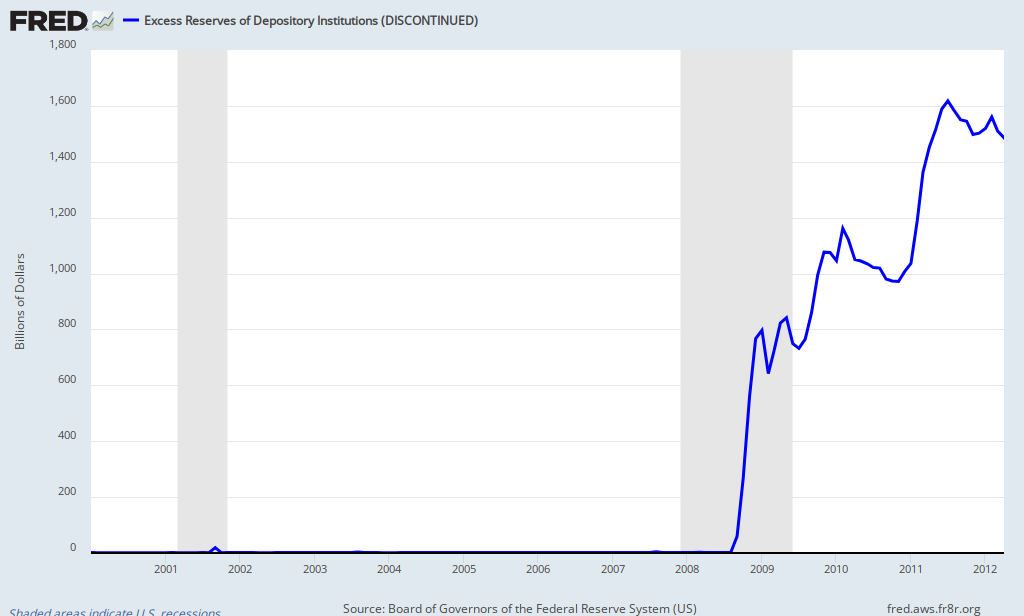
The chart above, which repeatedly has been in focus on this blog (most recently by dre cummings), shows that our banks continue to hoard vast wealth that could fund massive economic growth through new loans or through alternative government programs other than massive subsidies for the megabanks. Two factors basically drive the banks to accumulate reserves rather than lend: severe risk aversion and the ill-advised decision by the Fed to pay interest on reserves for the first time in October of 2008--thus, putting a decidedly contractionary influence upon monetary policy at the onset of a major downturn.
This new program also represents a massive transfer of money to the banks from the government. The Fed pays about .25 percent to encourage banks to hold reserves. During that same period the equivalent investment in Treasury obligations would have essentially zero yield. Basically, over four years we gave the banks about $100 billion for not investing the vast wealth that we pumped into the financial sector to keep it afloat after the financial crisis caused by the obscene recklessness of the banks. This constitutes the worst corporate welfare program in our history, for it is at once the most economically counterproductive and morally reprehensible use of social wealth imaginable. It is in short, a reflection of a banktatorship.
On May 31, I flew to Spain. Spain is today ground zero in the financial crisis and I wanted to see first hand how Spaniards are coping and what they think about the bank crisis. Just like the US, Spain is quickly shedding social programs and stunting its economic growth in order to turn the nation state into a giant bank welfare state. Thus, for example, Spain has dramatically cut coal subsidies resulting in thousands of lost jobs in the coal sector despite the fact the nation already has a 25 percent unemployment rate. At the same time, Spain is poised to inject nearly $25 billion into one of its largest banks, and the IMF suggests a total of at least $50 billion will ultimately be needed.
The economic carnage in Spain and Greece is a warning to America. Austerity for everyone but the banks is a cruel and suicidal policy. No economy can function when the state becomes an appendage of big finance. The only winners are senior bank executives and their cronies in government. Who would invest in such a pseudo-capitalist society? If banks suck all of the oxygen out of an economy who will buy any good and services produced? The brewing Euro-depression stands as a stark reminder to America that giving all social wealth to a small handful of banking elites (a policy that originated in America with the repeal of Glass-Steagall) will destroy an economy and lead to mass impoverishment.
The megabanks must be broken up and this remains the biggest issue of the coming political campaign--which likely will not even be on the table given the bi-partisan nature of the American banktatorship.
Thursday, May 31, 2012
A Shining Illustration of a Dangerous Truth: London 2012

Essay by Chris Dekki
The imagery is powerful. The symbolism is deeply imbedded in countless minds. The victories are an unmatched source of pride for millions of people. There are few things in the world more alluring than a grand competition where athletes (although no longer vying for dominance in the nude and to the exclusion of women) come together from every region of the world under the banner of the colorful Olympic rings. Undoubtedly, the Olympic games are important events both throughout history and in the present. Their existential purpose is to remind governments about the unshakeable unity of the single human family. Even the most cynical person cannot deny being moved by the sight a young athlete beaming with pride as he or she holds up a gold medal for the entire world to see. Yes, whether played out in the warmth of the summer or the cold of a snowy winter, the Olympic games are truly a spectacle to be experienced. Now, keeping all of this excitement and pride in mind, there is one reality that logically follows from the abundant Olympic hoopla: audience. The Olympics attract a massive, truly global audience that is ready to be mesmerized by feats of strength, skill, and courage. Thus, wherever there are willing consumers ready to submit to the pleasures of entertainment, there is businesspeople lying in wait, prepared to pounce on the lucrative whims of the masses. To many people, the Olympics are much more than simply an opportunity for humanity to come together in peace and harmony for some innocent athletic amusement. To the business-minded, the Olympics are an unmatched golden opportunity upon which only a fool would elect not to capitalize.
This year’s summer Olympics in London are no exception to previous tried and true business models. A quick glance at the list of “partners” of the 2012 Olympics demonstrates the critical function of corporations in the development of the games. These corporations have served as promoters, supporters, and goods and services suppliers to the organizers in London. Without their assistance, the games would most likely not be as cost-effective, profitable, or ostentatious. Nevertheless, entrenched in this major corporate position in the London games, is a reflection of the role corporations play in the everyday lives of human beings throughout the globe. As the recent revolts of the Occupy Wall Street movement have revealed, corporations wield outsized influence over the decisions of lawmakers in parliaments and legislatures from North America to Asia. Thanks to the corrupting nature of money, leaders in government, desperate to retain their tenuous elected positions, have transformed into pawns in which wealthy corporate players can buy and sell their political loyalties. In this modern era of complex local, national, regional, and international governance, it is the wealthy who have the capacity to play the biggest part in the world’s intricate political game. Undoubtedly, because of this global reality, it is the international corporate elites who surely exert the greatest authority over the international system.
Certain areas of the law have been especially affected by the financial might of corporations. In terms of public health law, corporations have been particularly successful in swaying the development of legislation. As the latest nutritional policy debacle in the United States Congress has shown, not even school children are safe from the power of lobbyists and corporate interest groups. Due to the efforts of organizations like the American Frozen Food Institute (AFFI), federal dietary regulations now promote the consumption of pizza as part of a child’s healthy daily school meal plan. Truly, this logic-defying state of affairs can best be understood by this horrifying statement: “‘This agreement [in Congress] ensures that nutrient-rich vegetables such as potatoes, corn and peas will remain part of a balanced, healthy diet in federally funded school meals and recognizes the significant amounts of potassium, fiber and vitamins A and C provided by tomato paste, ensuring that students may continue to enjoy healthy meals such as pizza and pasta,’ said Kraig Naasz, president of the American Frozen Food Institute.” Yes, thanks to the noble efforts of men like Kraig Naasz and his colleagues at the AFFI, children can now enjoy healthy servings of pizza and pasta at school. Truly, there is no better brain food for developing minds than a greasy helping of frozen cheese pizza topped with a mere smudge of antioxidant packed tomato paste. Notwithstanding the negligent health benefits of a spoonful of canned tomato paste, there is a serious connection between government frozen food regulations in the United States and the numerous corporate sponsorships of the 2012 Summer Olympics in London. At the very pinnacle of health and fitness stands the greatest athletic competition in the history of mankind: the Olympics. In promoting the value of sport and physical vigor, the Olympics should theoretically transcend the mighty vice grip of corporations over the direction of national and international public health policy. Nevertheless, some of the very corporations that have greatly affected public health have managed to secure a position of influence over the London Olympics. Some of the guiltiest of these corporate offenders are Coca Cola, McDonalds, Dow Chemical, BP, and several others. Yet these corporations are featured partners in what is supposed to be the greenest, most environmentally friendly, most sustainable games in history. Some of these corporate entities are not only swaying public health policy for the worst, they are also guilty of highly destructive environmental disasters that have had long-lasting effects on human health and environmental sustainability.
The 2012 London Olympics are a lens through which the pervasiveness of corporate influence over national and international public health law and policy can be analyzed. The London games are a microcosm of a larger international problem that has reared its ugly head on every continent. As the world struggles with the harmful effects of oil spills, chemical catastrophes, and decadent fast food, the corporations at the helm of selfish political activism have now successfully conquered London. They have shamelessly inserted themselves into an event that is meant to showcase some of humanity’s greatest attributes. Now, the Olympics are nothing more than free advertising for a group of corporations that have done little in the recent past besides earn exorbitant profits at the expense of human welfare. So as the world sits back, bites into a Big Mac, sips on a coke, and remains fixated on the Olympics, hopefully more people will recognize the sheer hypocrisy of it all.
(photo of London Olympic Clock by Chitrapa courtesy of Wikimedia Commons)
Tuesday, May 29, 2012
Eurozone Crack-up Will be Worse than Lehman

Athens is burning and the whole world fiddles. In fact, the crisis seems to have confirmed rumors of the decline of the west. The Euro hit a 2 year low today, reflecting real economic dislocation afoot in the Eurozone. S&P downgraded five Spanish banks last week. And, late today, the ECB turned down a request from Madrid to assist in bailing out its financial sector. The Eurozone crisis may well be the worst managed financial crisis in history. After all, Europe has the resources to grow out of this crisis.
In any event, a split has emerged: some commentators think a Grexit will lead to financial chaos; but, some think it can be managed.
The problem is that a Greek exit from the Eurozone would disrupt trade, impede investment, and cause massive cash hoarding as depositors, businesses and financial institutions all would try to move rapidly out of Greek denominated assets and into safe havens like Germany, Great Britain and the US. Soon Spain and Italy would be suspect and they would follow Greece down the tubes into debt-deflation. The volume and speed of risk aversion and capital flows would make Lehman Brothers look like a walk in the park.
Subscribe to:
Posts (Atom)


